
Transcript · Download MP3 · Download MP4
Invitation
Clean the house. Do the taxes. Organize the boxes. Make dinner. Change my life.
The body hears a task with no clear boundary and prepares for an enormous demand. We jab the adrenals, feel anger and overwhelm, imagine exhaustion or failure—and then need a nap before anything begins.
Often the actual movement is tiny: lift one candle and wipe beneath it, look up the phone number, take out the pan, label a folder Taxes, put one bottle away.
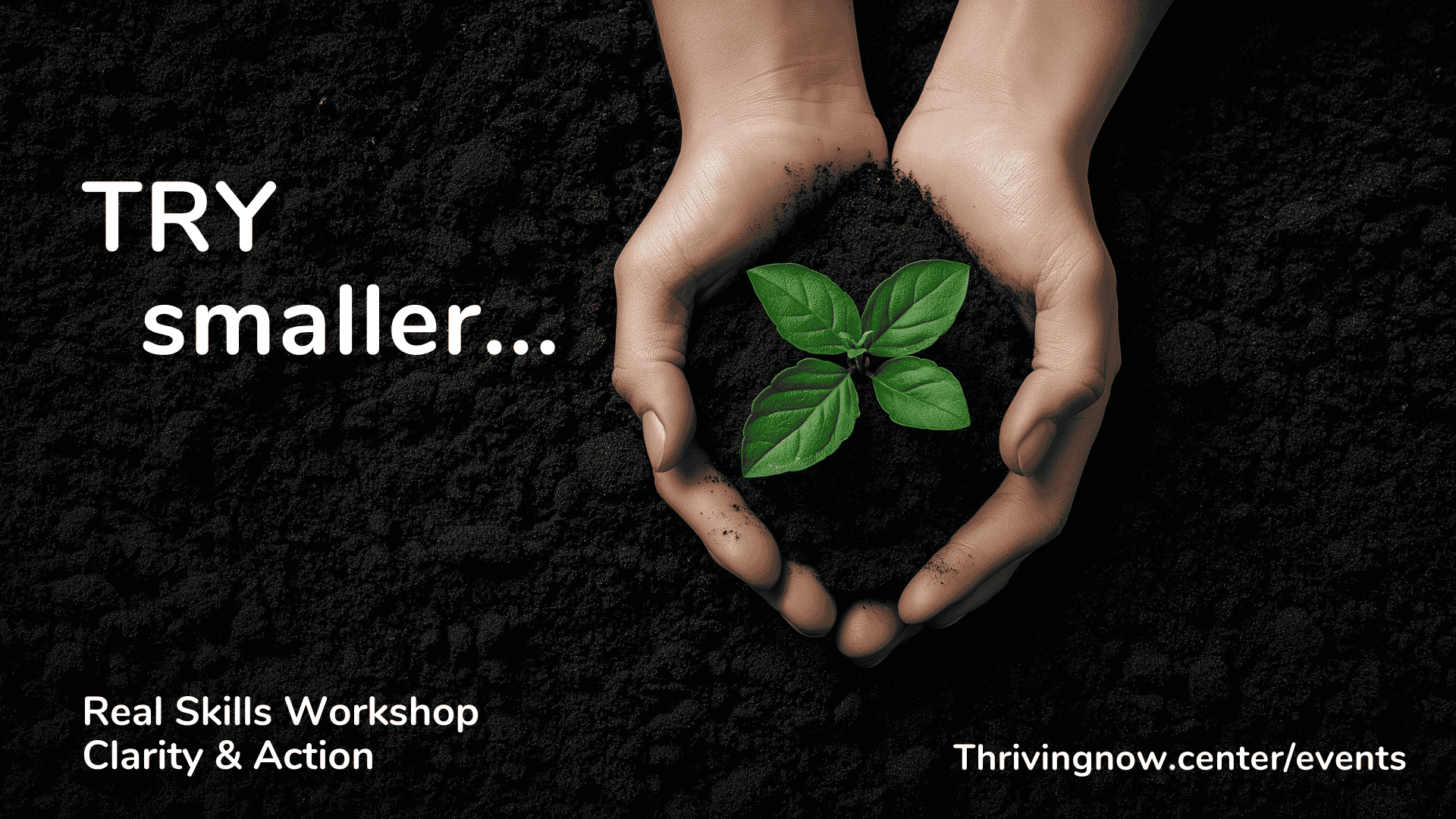
Trying smaller is not a productivity trick for squeezing more labor out of ourselves. It is an energy skill. It helps us replace primitive-brain pressure with presence, specificity, stewardship, and actions small enough for life force to move.
The ridiculously small step is not merely a fragment of the “real” work. It is a complete act of relationship with our present self, our future self, and what matters.
Notice When You Make It Bigger
Say, I have to clean the whole house. What happens in the body?
The phrase is undefined. Does “clean” include toothbrushes in the window tracks? When is a whole house ever finally done? The survival brain regulates energy and sensibly resists signing a contract with no scope or endpoint.
We also attach magical rewards:
- Once this is finished, I can relax.
- Then I will be a good person.
- People will love or respect me.
- I will finally like myself.
- My life will feel under control.
Some wise part knows the task cannot deliver those promises. Relaxation, worth, and belonging are not contingent on the closet. Release the false contract, then ask whether one change would simply feel right in the ecosystem.
Tapping: I Keep Amping Up the Task
Side of the Hand: Even though I turn this task into an emergency and jab myself with adrenaline, I know what happens next—my body refuses, crashes, or protects me from the way I am trying to do it.
Top of the Head: The whole thing has to be done right now.
Eyebrow: I am getting myself ramped up.
Side of the Eye: The task feels enormous and undefined.
Under the Eye: Then my body needs to recover from imagining it.
Under the Nose: My body does not know how to use all this alarm.
Chin: If I work from here, I may exhaust or injure myself.
Collarbone: And I probably will not finish the infinite version anyway.
Under the Arm: My resistance may be wise about the approach.
Top of the Head: I can stop hiring my primitive brain as foreman.
Eyebrow: I can define one thing and one endpoint.
Side of the Eye: I do not need worth or rest as a prize.
Under the Eye: Those belong to me before the task.
Under the Nose: I can act because one change feels right.
Chin: I can tend my fishbowl without putting myself on trial.
Collarbone: Less pressure leaves more energy for movement.
Under the Arm: I am open to the ridiculously small doorway.
Take a breath. Ask, What is the smallest visible action—not the smallest version of the whole demand?
Define the Next Physical Movement
“Make soup” contains dozens of decisions. “Put the Instant Pot on the counter and plug it in” is a physical movement.
“Get new glasses” becomes “find the phone number.”
“Do taxes” becomes “label one folder Taxes.”
“Clean the mantle” becomes “lift the plant and wipe the space beneath it.”
The next step should be so clear that the body knows what participation costs. If more energy arrives, we may continue. Continuing is a bonus, not proof the first step was secretly a manipulation.
When we return later, our past self has gifted us ease. The pan is waiting. The folder exists. Energy has already entered the field. Momentum may arise, but trying smaller is successful even when it does not.
One Tiny Act Can Be Complete
Modern task culture treats partial action as failure. Emotional ecology sees a glass of water placed for someone, one dish put away, or one shoulder softened as complete acts of tending.
The world’s asking is infinite. Empathetic responders can be drained by children, clients, bodies, homes, and causes because there is always more to do. Trying smaller helps us feel what is ours and what is done for now.
An atom holds enormous energy. One subtle movement of kindness, appreciation, presence, or care also has integrity. It need not knock down trees to matter.
Tapping: Small Does Not Feel Like It Counts
Side of the Hand: Even though one tiny action feels embarrassingly insufficient compared with everything asking from me, I have finite life force, and I want to learn the completeness of a good and sufficient response.
Top of the Head: One thing cannot possibly be enough.
Eyebrow: Look at everything still undone.
Side of the Eye: The world has infinite asking.
Under the Eye: My empathy can feel all of it.
Under the Nose: If I stop, someone or something remains unmet.
Chin: No wonder I make every response enormous.
Collarbone: My energy is precious and finite today.
Under the Arm: A small act can still be wholehearted.
Top of the Head: This glass of water is complete.
Eyebrow: This one paper has a home.
Side of the Eye: This tiny neck release changes my whole system.
Under the Eye: I can feel when the response is enough for now.
Under the Nose: Future me can receive today’s small gift.
Chin: Care does not become real only at exhaustion.
Collarbone: Subtle acts carry artistry, kindness, and presence.
Under the Arm: I can be a responder without answering infinity.
Take a breath. Let one modest act have a period after it.
Stop Weighing Everything in Your Mind
Mental prioritizing can consume more life force than the actions. We hold the entire list in awareness, compare every item, rehearse consequences, and become weighed down by weighing.
Try a different orientation: What is here for me now?
This is not abandoning responsibilities. It is shifting from control into stewardship and tending. We can watch sunlight on leaves, then discover energy moving toward half a refrigerator shelf. We may take out the pan and stop. Presence allows surprise and guidance that rigid lists filter out.
For rule-followers, this can feel dangerous: If I stop controlling myself, I will burn down the house. Adults usually have more regulation than the frightened part imagines. Experiment within real boundaries and see what your being chooses.
Tapping: Mental Weighing Is Weighing Me Down
Side of the Hand: Even though I keep every priority active in my mind so nothing important is lost, this endless weighing taxes my life force, and I want a more present way to tend what matters.
Top of the Head: I am mentally weighing everything.
Eyebrow: And the weighing is weighing me down.
Side of the Eye: What if this pressure is my wisdom objecting?
Under the Eye: Is prioritizing every task how I want to live?
Under the Nose: I could make a list long enough to consume my life.
Chin: I am powerful enough to invent infinite obligation.
Collarbone: No wonder my being wants another way.
Under the Arm: I can preserve commitments without carrying all of them now.
Top of the Head: What is one thing here for me now?
Eyebrow: What feels like stewardship rather than force?
Side of the Eye: What would be good and sufficient?
Under the Eye: I can listen for body guidance.
Under the Nose: I can pause after the smallest yes.
Chin: Surprise is allowed inside a responsible life.
Collarbone: Presence may show me what planning concealed.
Under the Arm: I can tend this moment without controlling the whole future.
Take a breath. Let the list exist somewhere outside your nervous system while you feel this one moment.
Trying Smaller with Emotion
Some tasks are large because of what they symbolize. Going through boxes may touch grief, identity, mortality, unrealized dreams, or fear of being empty and alone. A guitar is not only an object; it may hold a hoped-for musical self. Craft supplies can hold an imagined future. Clutter can protect us from the quiet in which we might meet ourselves.
Do not turn “process the grief” into another giant task.
- Imagine one object leaving and notice the reaction.
- Feel one sensation for half a second.
- Ask what you would grieve if the box vanished.
- Turn sorting into a treasure hunt for one thing you are glad to find.
- Let a trusted person open one box with you.
- Research one possible future home for an object without committing to give it away.
Smaller may mean a different doorway, not merely a smaller workload.
When we let go, what mattered need not disappear. Music, creativity, improvisation, surprise, and delight can return in new forms. Releasing the old costume creates room for a better-fitting expression.
Tapping: The Small Object Holds a Big Grief
Side of the Hand: Even though this object, box, or unfinished project holds a dream and letting it go feels like losing part of me, I will not force a decision; I can meet one thread of the grief with support.
Top of the Head: This was supposed to be part of my life.
Eyebrow: I attached hope and identity to it.
Side of the Eye: Letting go says that time and bodies are finite.
Under the Eye: I cannot live every possible life in this form.
Under the Nose: That truth deserves tenderness.
Chin: I do not have to swallow all the grief at once.
Collarbone: Half a second of honest feeling is enough.
Under the Arm: I can step back and let my system recover.
Top of the Head: What mattered underneath this particular form?
Eyebrow: Music, beauty, learning, connection, or possibility?
Side of the Eye: The form may end while the value remains alive.
Under the Eye: I can explore another doorway without betraying the dream.
Under the Nose: I can keep, release, donate, repurpose, or wait.
Chin: No decision is required in this tapping round.
Collarbone: Space may eventually welcome something surprising.
Under the Arm: I can let this understanding mature over time.
Take a breath. If grief is strong, stop with the kindness of having noticed it. That is the small act today.
Practices for Living This Skill
- Translate into motion. Replace a project label with the next visible action a body can perform.
- Make it ridiculously small. If the nervous system still braces, divide again.
- Define done-for-now. Give the action an endpoint before beginning.
- Release the magical payoff. Remind yourself that worth, love, and permission to rest do not depend on completion.
- Let the first step be honest. Do not use a tiny action as a disguised demand to finish everything.
- Notice the gift from past self. When you return, appreciate whatever ease the earlier action created.
- Externalize the list. Keep commitments in a trusted system instead of mentally weighing them all.
- Ask the body and environment. What are my bones asking? What is this room asking? What is here now?
- Use alternate doorways. Research, imagine, treasure-hunt, ask for company, or feel the emotional reaction before doing the task.
- Celebrate sufficiently. Pause after one movement and let the nervous system register that small action can feel good.
Bringing It Into Your Life
We were often taught to dream big, push hard, and make one heroic effort prove our worth. That orientation can turn a dusty mantle into a month of shame and a two-minute task into a mountain.
Trying smaller returns us to the essential nature of what matters. We use precious time, energy, and presence in doses the body can metabolize. We learn that tending is not the same as finishing infinity.
Sometimes the pebble begins a path. Sometimes it is simply a pebble moved with care. Both count.
See the giant. Find the pebble. Move what is here. Let that be enough for now.
Continue the Conversation
Questions, reflections, and real-life examples are welcome. Continue the conversation about Try Smaller in the Thriving Now Center.