
Transcript · Download MP3 · Download MP4
Invitation
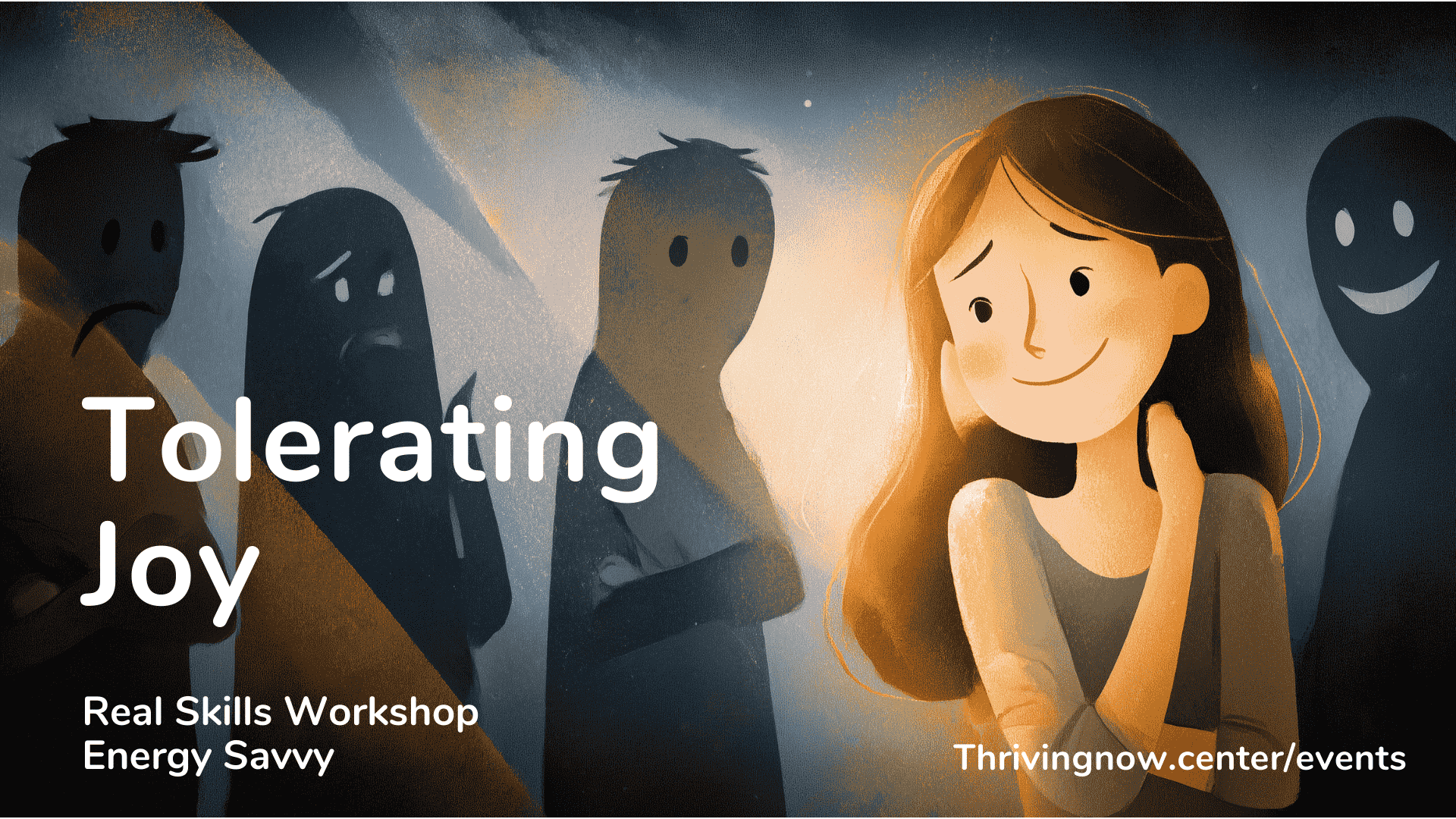
It sounds strange that joy might need to be tolerated. Shouldn’t joy be the easy part?
For a nervous system shaped by sudden crashes, envy, criticism, chaos, or caregivers who could not tolerate a child’s aliveness, joy may trigger vigilance. Do not get too excited. Something bad comes next. Someone will take it. You will look foolish. You will be punished for forgetting the danger.
Tolerating joy means expanding our capacity to receive goodness without forcing intensity, denying risk, or requiring the feeling to last.
This is trauma-informed joy. We notice sensation before story, work with specific learned linkages, protect what is precious, and practice small sips in spaces where our joy is welcome.
Feel the Sensation Before Explaining It
Bring to mind a modest moment of joy and pause the scene. Before deciding what it means, notice the body. Is there warmth, expansion, tingling, breath, energy up the spine—or tightness, bracing, numbness, and the impulse to look around?
The body may hold stimulus-linked memories without offering a neat narrative. Sensation gives us a place to begin without inventing certainty.
Joy also has many natural flavors. It may be exuberant cheering. It may be the quiet pleasure of moss on a trail, effortless roller skating, or a hand resting on the heart. We do not need to perform somebody else’s chemistry to prove we are joyful.
Tapping: Letting the Body Define Joy
Side of the Hand: Even though part of me cannot quite feel joy—or feels something complicated when I try—I am willing to listen to sensation without making myself wrong.
Top of the Head: Feeling what is here, not forcing it.
Eyebrow: My body may remember more than words can explain.
Side of the Eye: Warm, tight, open, vigilant, numb, alive.
Under the Eye: Any honest sensation is useful information.
Under the Nose: I do not need a joyful performance.
Chin: I can tap while I notice.
Collarbone: Curious rather than judging.
Under the Arm: Making room for my actual flavor of joy.
Top of the Head: Perhaps joy is quiet in me.
Eyebrow: Perhaps it comes as a deeper breath.
Side of the Eye: Perhaps it wants a sound or movement.
Under the Eye: I can follow what feels authentic.
Under the Nose: I can stop before it is too much.
Chin: My nervous system sets today’s dosage.
Collarbone: A small shift is real.
Under the Arm: I am learning the sensation of receiving.
Take a breath. Let joy be exactly as noticeable—or unnoticeable—as it is.
When Joy Predicts a Crash
The nervous system learns sequences. Excitement was followed by a broken arm, a sting, humiliation, rage at the dinner table, or someone puncturing the tender place until the feeling disappeared. The system may conclude that preventing the high is the safest way to prevent the crash.
General tapping on joy is unsafe can help. Specific events usually give more leverage. Choose one manageable scene and work with the sensory details: the face you saw, the sound in the room, the instant the body went from open to braced.
The aim is not to prove crashes never happen. It is to update the fusion: joy and danger are not one indivisible event now.
Tapping: The Crash Taught Me Not to Fly
Side of the Hand: Even though that crash really hurt and my body learned that it could not afford to fly high, I appreciate the protection and want to explore whether a little joy can be safer now.
Top of the Head: Remembering that specific crash.
Eyebrow: I thought my heart would break.
Side of the Eye: I did not know how to handle it.
Under the Eye: The people around me may have added to the trauma.
Under the Nose: My body glued joy to what happened next.
Chin: Suppression was a solution.
Collarbone: It cost me so much nourishment.
Under the Arm: And it helped me feel more in control.
Top of the Head: I am not that powerless child now.
Eyebrow: I can choose a two-out-of-ten joy.
Side of the Eye: I can try it for ten seconds.
Under the Eye: I can practice when no unsafe person is watching.
Under the Nose: I can transition instead of crashing.
Chin: I can learn without reliving everything.
Collarbone: Joy does not have to equal danger now.
Under the Arm: Baby steps are a wise place to start.
Take a breath. Look around and let your body register where and when you are now.
Other People’s Joy Can Activate Our Alarm
Exuberance may feel loud, chaotic, enmeshing, or unfair when we cannot access our own joy. Reactivity does not necessarily mean we want others to suffer. It may mean too much energy, too fast, in a place where I cannot escape.
Ask two different questions:
- Is this expression allowed in this space?
- What do I need because it is too much for me right now?
A child playing loudly in a playroom may be within the agreement, while a person trying to write has a valid need for quiet. Permission and preference can coexist. We can move, request a transition, use protection, or choose another time without making joy itself the villain.
Tapping: Their Joy Is Allowed and I Have Needs
Side of the Hand: Even though their joy floods my system and part of me wants it stopped, I want to separate what is allowed from what I need and respond with more choice.
Top of the Head: Too much joy here.
Eyebrow: Too loud, too big, too fast.
Side of the Eye: A part of me learned to sound the alarm.
Under the Eye: I may resent what I cannot feel.
Under the Nose: That is uncomfortable to admit.
Chin: I actually want freedom for both of us.
Collarbone: This is the safety part flaring.
Under the Arm: I can honor it without suppressing everyone.
Top of the Head: Is this expression allowed here?
Eyebrow: If yes, what support do I need?
Side of the Eye: Distance, quiet, notice, or a transition.
Under the Eye: I can make a clear request.
Under the Nose: I can choose a different space.
Chin: I can be considerate without erasing myself.
Collarbone: Their joy and my boundaries can coexist.
Under the Arm: Savvy is better than suppression.
Take a breath. Name one need without judging the other person’s aliveness.
Differentiation Lets Joy Belong to Us
In enmeshed systems, everyone is expected to match the room. A joyful child may be told to calm down because a depleted adult cannot tolerate the contrast. We learn that feeling good is disloyal, dangerous, or selfish.
Differentiation says: My joy is mine. Your feeling is yours. I can care about you without matching you. We still consider context and consent. We simply stop treating emotional sameness as the price of belonging.
Some people reliably puncture joy. They may be protecting against their own fear, acting from envy, or deliberately targeting what is tender. We do not have to settle their motive before protecting ourselves. Do not hand a precious experience to someone who repeatedly harms it. Savor privately, share with safer people, step away, or say internally: You do not get to have this. It is mine.
Tapping: Little Sips of Joy Are Mine to Keep
Side of the Hand: Even though I learned joy was unsafe—especially in connection with certain people—I am seeing that not every lesson meant joy itself was dangerous, and I can choose where I practice.
Top of the Head: I learned to turn joy down.
Eyebrow: Now I am learning how to turn it back on.
Side of the Eye: What if I allow one little sip?
Under the Eye: Even if someone might disapprove.
Under the Nose: Baby steps.
Chin: Little sips of joy.
Collarbone: It does not have to be perfect.
Under the Arm: This moment already contains something good.
Top of the Head: Tapping can be a sip of joy too.
Eyebrow: I am here with people who want my thriving.
Side of the Eye: I can practice with safer humans.
Under the Eye: I do not have to share with a joy-taker.
Under the Nose: This goodness is mine to receive.
Chin: I can protect it without going to war.
Collarbone: More Vitamin J may nourish me.
Under the Arm: I am practicing tolerating and sipping joy.
Take a breath. Notice whether there is one percent more permission in the body.
Transition Instead of Clinging or Crashing
Every emotional state moves. Trying to hold joy indefinitely can become another form of control. A sip held in the mouth for forty minutes is no longer a sip.
Notice the edge where joy has been enough. Catch it softly: That was wonderful. I want to remember it. Now my system wants quiet. This teaches the body an ebb and flow rather than a high followed by catastrophe.
The capacity will grow. A ten-second sip may become the ability to receive joy while juggling a busy morning. We are not trying to live at a ten. We are making the full range more inhabitable.
Practices for Living This Skill
Find Your Two-Out-of-Ten Joy
Choose something modest enough that the body does not immediately brace. Stay for three to ten seconds.
Work One Specific Link
Instead of joy always crashes, tap on one scene when openness changed suddenly into danger or shame.
Locate Safe Witnesses
Notice who rides with your joy without competing, correcting, or poking. Share appropriately with them.
Practice an Authentic Expression
Hum, breathe deeper, put a hand on your heart, smile, move, or remain quietly radiant. Your joy does not need a costume.
Complete the Transition
Say: That was nourishing. I am letting it settle now. Let joy become memory and capacity rather than something you must clutch.
Protect Without Explaining Everything
If someone repeatedly takes the good from you, reduce access. Reality-based protection is part of joy tolerance.
Bringing It Into Your Life
We do not become safer by removing joy from our lives before anyone else can. We become safer by learning dosage, discernment, protection, expression, and transition.
Joy can be quiet. It can be brief. It can coexist with grief, urgency, and imperfection. Each sip teaches the body that goodness can arrive, be received, and move on without destroying us.
A little joy. In a safe-enough place. Long enough to let it land.
Continue the Conversation
Questions, reflections, and real-life examples are welcome. Continue the conversation about Tolerating Joy in the Thriving Now Center.