
Transcript · Download MP3 · Download MP4
Invitation
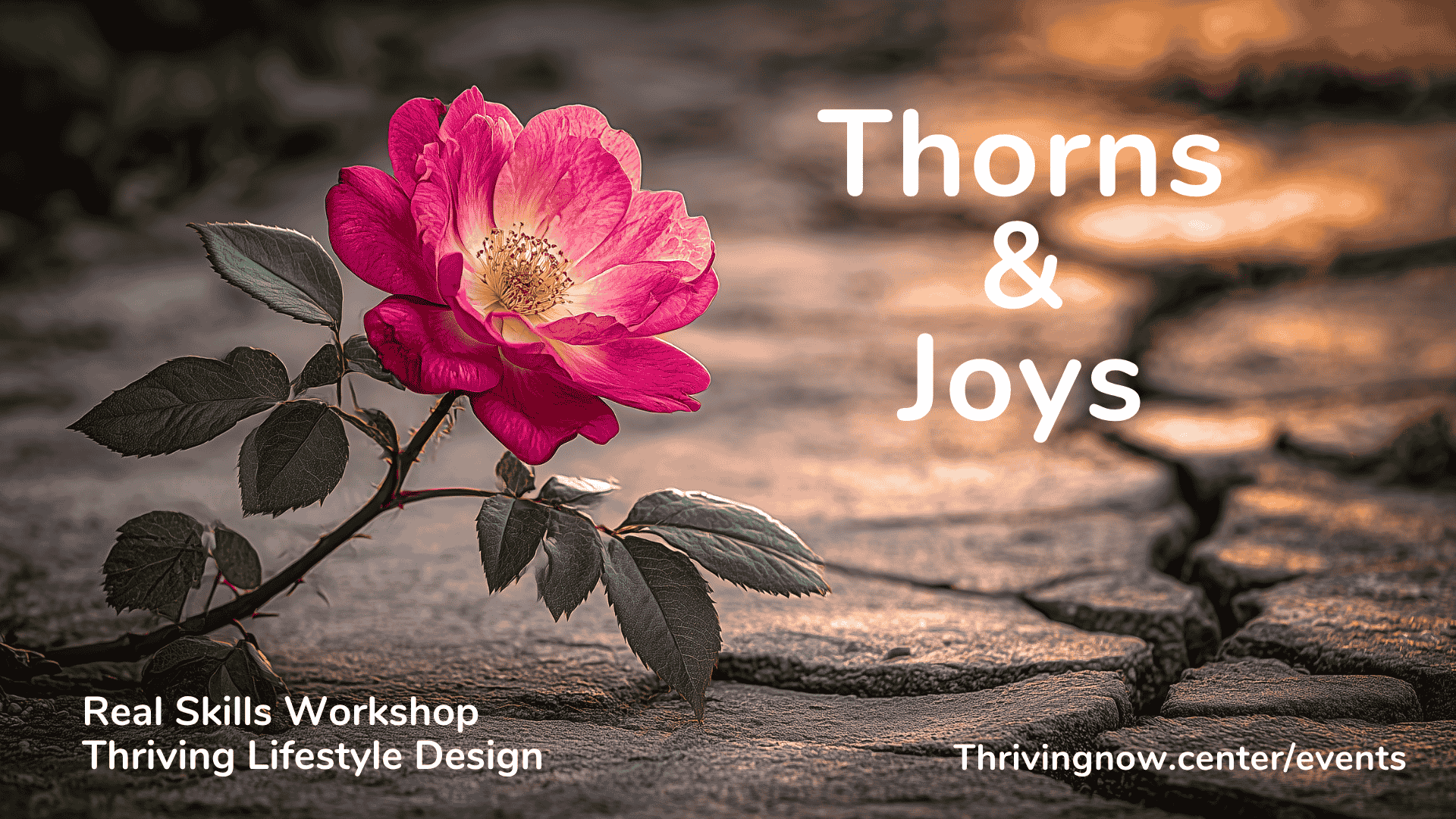
Life does not wait until every problem is solved before offering us something beautiful. A painful diagnosis and a caring hand can arrive in the same week. A difficult conversation can happen beneath a blue sky. The news can break our heart while coffee still smells wonderful and birds continue singing.
Many of us learned to postpone enjoyment until everything is okay. Others learned that noticing anything good while something terrible is happening means we are minimizing the harm, abandoning our vigilance, or letting someone off the hook. And when the nervous system is in immediate danger, noticing the flower truly is not the priority. Survival attention is supposed to narrow.
The skill is not forced positivity. It is developing enough capacity to acknowledge the thorn, tend what needs tending, and—when our system has room—also receive what nourishes us.
This is the practice of and. Not thorn or joy. Not pain disguised as a blessing. Not joy postponed until perfection. Reality can contain both, and a thriving life needs the capacity to meet both.
Start with Reality, Not an Assignment to Feel Good
If a tiger is biting your leg, get away from the tiger. If you are flooded, dissociated, or in active crisis, your body may not have the bandwidth for nuance. The primitive brain directs resources toward escape, defense, collapse, or appeasement. It is not failing because it does not pause to admire the light.
This matters because emotionally diligent people can turn every useful skill into another standard they are failing to meet: I should be able to find joy in this. What is wrong with me?
Nothing is wrong with you. Capacity changes with circumstances, healing, rest, support, and practice. The invitation begins when you can truthfully say:
This is painful. I am not in immediate physical danger right now. Is there room to notice one other thing that is also true?
Sometimes the answer is no. That is useful information. Sometimes there is one percent of room. That is enough for practice.
Tapping: Giving the Thorn Appropriate Attention
Side of the Hand: Even though my primitive brain is noticing every problem, and there seem to be so many, I appreciate that it is trying to protect me, and I want to give each concern the attention it actually needs.
Top of the Head: Thank you, primitive brain.
Eyebrow: You have such a long list of threats.
Side of the Eye: Some of them truly need my attention.
Under the Eye: Some are not mine to solve right now.
Under the Nose: I can be aware without dwelling constantly.
Chin: I do not have to live at the bottom of the trauma well.
Collarbone: What would appropriate attention look like?
Under the Arm: I can tend what matters without feeding every alarm.
Top of the Head: Perhaps that creates a little more space.
Eyebrow: Space for something else that is also happening.
Side of the Eye: Sometimes holding both is really hard.
Under the Eye: This is a capacity I can build like a muscle.
Under the Nose: Gentle practice is enough.
Chin: I do not need to force a big feeling.
Collarbone: One breath, one color, one kindness may be plenty.
Under the Arm: What if I practice a little bit right now?
Take a breath. Feel your feet, your seat, or the inside of your spine. Let the thorn keep its truthful size. Then notice whether anything else enters the picture.
The Powerful And
And does not weaken the first truth. It widens the field.
- This loss hurts, and I can feel how much I care.
- The relationship has thorns, and there are moments of genuine meeting.
- I am worried about what is happening, and I have support for this hour.
- The squirrels do not belong in the attic, and the young squirrels playing in the tree delighted me.
- This day was awful, and it is finally over.
The second truth does not need to qualify as joy. Goodness, care, meaning, relief, satisfaction, beauty, usefulness, or aliveness can be more honest. The aim is not to manufacture woo-hoo energy. It is to stop excluding nourishment merely because pain is present.
This protects us from two distortions. Spiritual bypassing refuses to see the thorn. Trauma fixation lets the thorn fill the entire field. The body tends to trust reality: Yes, this is here. And what else is here?
Tapping: Learning to Hold Thorns and Flowers
Side of the Hand: Even though I was not taught to hold both, and it may not have felt safe to show joy around people who were hurting, depleted, or reactive, I am in a different place now, and I am building this skill now.
Top of the Head: It is not all black or all white.
Eyebrow: Amidst the thorns there are often flowers.
Side of the Eye: Just ask nature.
Under the Eye: Inside me there are thorns and flowers too.
Under the Nose: My body may need time to hold both.
Chin: I can begin with little bits of goodness.
Collarbone: Something that pleases me.
Under the Arm: Something that stirs my heart.
Top of the Head: Something that makes me giggle or soften.
Eyebrow: Let that be part of the picture too.
Side of the Eye: I am not denying what hurts.
Under the Eye: I am including more of what is real.
Under the Nose: I can receive nourishment while I tend the thorn.
Chin: This matters for my nervous system.
Collarbone: It matters for my resilience.
Under the Arm: It is essential for my thriving.
Take a breath. If joy feels too big, find something merely pleasant, steady, or okay.
Micro-Joys Teach the Body to Receive
A thorn recruits the whole body automatically. Heart rate, muscles, hormones, and attention all mobilize. A small pleasure may pass in seconds unless we intentionally let it register.
Choose something already woven into your life: the first sip of coffee, clean clothes, warm water, a favorite color, a flower beside the trail, the feel of a blanket, a funny exchange, or the satisfaction of having stocked something the household needs. Pause for roughly seventeen seconds—not as a magic number, but as permission to linger.
Smell the coffee. Hear the gurgle. Feel the cup. Let yourself have the moment.
This is not another productivity assignment. It is an experiment in assimilation. The world may offer pleasure while a survival-trained system remains unable to take it in. Savoring helps the experience land in the body rather than disappear as an unnoticed fact.
At first, dual awareness can require surprising energy. New neural and emotional patterns often do. One second may become five, then a minute. If the practice remains consistently exhausting, listen for a belief beneath the effort:
- It is unsafe to relax.
- I do not deserve enjoyment while others suffer.
- If I stop watching, something bad will happen.
- My happiness will upset someone.
- I need permission from an authority figure before I can enjoy this.
Those are not reasons to push harder. They are precise aspects to meet with tapping, compassion, boundaries, and sometimes professional support.
Internally Referenced Joy
External appreciation and companionship are precious. Yet if access to goodness depends entirely on someone else reflecting it to us, joy becomes fragile.
Being internally referenced means we can recognize what matters from inside. Put a hand over your heart if that feels supportive. Sense the inside of your spine, the space in front of it, the lungs and heart, the living energy held there. Ask:
Who and what is present in this inner space? What is precious to me? What do I know about the person I have become?
A gift from a friend can bring joy because of the friend. It can also reflect your capacity to cultivate a loving, reciprocal relationship over many years. A piece of art can remind you that expression moves through you. A moment of wise parenting can show you the strength and understanding you have built.
The joy becomes more than an object or compliment. It completes a circuit of recognition inside.
Resentment, Grief, and the Demand That Life Be Fair
Many of us absorbed a bargain: if we are good, work hard, care deeply, or follow the rules, terrible things should not happen. When reality violates the bargain, resentment can lock our energy around This should not have happened.
Sometimes it absolutely should not have happened. Processing does not require calling injustice beneficial, forgiving the person who caused it, or discovering a hidden blessing. We can be angry, grieve, act, set boundaries, and insist on truth.
The question is whether staying fused with the protest is still protecting us—or preventing life force from moving toward the care, action, and nourishment available now.
Tapping: This Should Not Have Happened
Side of the Hand: Even though I thought bad things should not happen because I am a good person, I care, and I work hard, I honor the part of me that is furious with life, God, the universe, or the people who let this happen.
Top of the Head: I really resent that this happened.
Eyebrow: I desperately did not want it to happen.
Side of the Eye: I do not like this.
Under the Eye: Part of me is holding the anger tightly.
Under the Nose: Part of me is holding the grief.
Chin: This should not have happened.
Collarbone: And it did happen.
Under the Arm: Reality brings such strange combinations.
Top of the Head: I do not have to find a blessing in this.
Eyebrow: I do not have to be glad it happened.
Side of the Eye: I can let the anger and grief move honestly.
Under the Eye: I can tend what matters because it matters.
Under the Nose: I can take a break without abandoning the issue.
Chin: I can move my body and feel my life force.
Collarbone: Right now, care for myself is good and wholesome.
Under the Arm: I can return to action with more of me available.
Take a breath. Ask whether the thorn needs action, protection, grieving, rest, or simply more witness before anything else can enter.
Receiving Joy Does Not Excuse Harm
An inner child may hear notice something good as admit they were right. Refusal then becomes loyalty to the truth: You cannot make me see anything good. I will hold on forever.
Respect that protector. It may have been the only part that never agreed the harm was acceptable.
Then make the distinction explicit: the sun shining today is not evidence that abuse was okay. Birds singing do not acquit the person who caused harm. Letting beauty reach you does not reopen contact, erase a boundary, require forgiveness, or change the historical record.
Joy is not a pardon you grant the person who hurt you. It is life force you stop making them powerful enough to confiscate.
Tapping: You Cannot Make Me See Anything Good
Side of the Hand: Even though I have this all-or-nothing protection, and noticing anything good feels like giving in, I respect the part of me that knows it was not just or right and refuses to betray that truth.
Top of the Head: I will only notice the bad things.
Eyebrow: You cannot make me see anything good about this.
Side of the Eye: I am holding on forever.
Under the Eye: That is my right.
Under the Nose: I can hold on as long as I need.
Chin: It was not right what happened.
Collarbone: I know it was not right.
Under the Arm: My strength helped me survive and remember.
Top of the Head: What if I can see something good and still know it was wrong?
Eyebrow: The sun is shining on me today.
Side of the Eye: That is not about what they did.
Under the Eye: The birds are singing today.
Under the Nose: That does not excuse how they behaved.
Chin: What if I can let some joy into my life?
Collarbone: I never have to say the harm was okay.
Under the Arm: My inner child can keep the truth and receive the flower.
Take a breath. Let the protective no remain. See whether it can guard the boundary while allowing one unrelated pleasure to belong to you.
Protection Is Part of Working with Thorns
Acceptance does not mean bare-handed exposure. If you work with a rose bush, gloves and careful distance make sense. If a person repeatedly wounds you, consider the energetic, psychological, and logistical protection that fits:
- What distance reduces injury?
- What subjects or depths are not available with this person?
- What preparation, time limit, ally, or exit helps?
- Am I calling something a minor thorn when I am actually being wounded?
- What adaptation would reduce harm without requiring me to deny reality?
Reframing is not shrinking a dangerous situation until it sounds pleasant. It is seeing more truthfully, without unnecessary amplification and without minimizing what your body knows.
Becoming the Human Your Future Self Will Need
Every time we process a thorn without abandoning ourselves, we build capacity. We become more like the person we needed when we were young—and the person our future self will need when life changes again.
Tapping: Building Resilience for My Future Self
Side of the Hand: Even though life will continue to include uncertainty and things I do not want, I appreciate the strength, wisdom, and emotional skill I have already built, and I am continuing for my future self.
Top of the Head: I have become stronger.
Eyebrow: I am collecting wisdom.
Side of the Eye: I am practicing skills that matter.
Under the Eye: I am accepting my imperfection.
Under the Nose: I am learning to live with uncertainty.
Chin: Some things truly are not the way I want them.
Collarbone: I am building resilience for my future self.
Under the Arm: Just as earlier versions of me built it for today.
Top of the Head: I appreciate the strength I have already developed.
Eyebrow: I am continuing in ways that fit me.
Side of the Eye: It matters to be wise and emotionally savvy.
Under the Eye: My future self may thank me for this practice.
Under the Nose: I can integrate what is good for me.
Chin: I can let the rest pass by.
Collarbone: I appreciate who I have already become.
Under the Arm: It is okay to savor that each day.
Take a breath. Feel appreciation as recognition, not pressure to perform gratitude.
Practices for Living This Skill
Ask “And What Else Is True?”
Name the thorn without softening it. Then ask what else is present. Accept nothing I can feel yet as a valid answer. Curiosity works better than command.
Give the Thorn an Appropriate Container
Decide when you will read the news, make the call, write the letter, have the conversation, grieve, or seek support. A container is not avoidance; it keeps the issue from occupying every room of your inner world.
Practice Seventeen Seconds of Receiving
Once a day, pause with a reliable micro-joy. Use your senses. Let the experience reach your body. If seventeen seconds feels demanding, begin with three.
Keep an And… List
At the end of the day, record moments worth remembering. Some days the honest entry may be This day is over. If more arrives tomorrow, add And… without criticizing yesterday’s capacity.
Track What Makes Joy Feel Unsafe
Notice the exact objection: Someone will be upset. I will become careless. This dishonors what happened. I do not deserve it. Tap on the objection rather than trying to leap over it.
Add Protection Where the Thorn Is Real
Use gloves, distance, boundaries, timing, help, or an exit. Joy practice should not be used to tolerate preventable wounding.
Let Goodness Be Modest
Look for relief, care, warmth, meaning, satisfaction, humor, or a little more room. Joy does not have to arrive with fireworks to nourish you.
Bringing It Into Your Life
The goal is not to become someone who smiles while being impaled. The skill is to know when survival needs the whole field—and when the field can safely widen again.
Thorns get attention for good reason. We tend them. We protect ourselves. We grieve what should not have happened. We act where action is possible.
And we stop waiting for a thornless life before allowing ourselves to live.
The coffee can be warm. The boundary can hold. The flower can be beautiful. The injustice can still be wrong. Our heart can ache for the world and receive the breeze on our skin. Each truthful and gives the nervous system more reality, more nourishment, and more choice.
Tending the thorn. Receiving the joy. Living the… And.
Continue the Conversation
Questions, reflections, and real-life examples are welcome. Continue the conversation about Thorns & Joys in the Thriving Now Center.