
Transcript · Download MP3 · Download MP4
Invitation
Humans are designed for cycles of activation and recovery. We mobilize, focus, protect, create, care—and then unwind enough for tissues, attention, and emotional energy to renew.
Many of us learned activation without a trustworthy return path. We carry the project, laundry, judgment, danger, and unfinished world inside our muscles long after action has stopped.
Relaxation is not doing nothing. It is allowing unnecessary tension to release so life force can circulate and restore us.
Notice the “I Can’t Relax Until…” Rule
Complete the sentence without editing:
I cannot relax until (?).
Is it: Until the work is done. Everyone is okay. The house is clean. The money is secure. The idiocy ends. No one can criticize me. I know I will remember everything.
Some conditions are legitimate: a child needs immediate care; danger must be addressed. Others are impossible finish lines. When relaxation depends on the end of all uncertainty or human foolishness, it never becomes available.
Tapping: I Cannot Relax Until It Is Done
Side of the Hand: Even though I cannot relax until this is done, the tension is now making it harder to do what matters.
Even though part of me believes strain is how I remember and stay responsible, I can use notes, boundaries, and choices instead of holding everything in my tissues.
Even though there is more to do, relaxation may help me meet it with greater capacity.
Top of the Head: I cannot relax until it is done.
Eyebrow: There is always more to do.
Side of the Eye: If I let go, I may forget.
Under the Eye: Tension proves I am responsible.
Under the Nose: It is also draining my ability to respond.
Chin: Is all this tension actually necessary?
Collarbone: Relaxation is natural and essential.
Under the Arm: I may work better with relaxed attention.
Top of the Head: What if I relax anyway?
Eyebrow: One shoulder, one breath, one minute.
Side of the Eye: Gravity can do some of the work.
Under the Eye: I can leave myself a reminder.
Under the Nose: I can return without holding the task in my jaw.
Chin: The work may remain real.
Collarbone: The strain does not have to remain constant.
Under the Arm: I am building a return path toward renewal.
The Transition Can Feel Worse Before It Feels Better
Moving from high activation toward rest may expose sensations that busyness covered: shaking, grief, fatigue, emptiness, or fear. The body may interpret downshifting as collapse or loss of defense.
Do not demand instant stillness. Walk, sway, tap, stretch, hum, or let the shoulders circle before asking them to drop. Relaxation can be active and gradual.
Meditation is not the only form. Chopping vegetables, savoring a drink, looking at the sky, walking, drawing, or letting the tongue rest can change state toward presence.
Tapping: Letting Down Feels Unsafe
Side of the Hand: Even though my system associates relaxation with being caught off guard, judged, or unable to defend myself, I respect that protection.
Even though softening may reveal exhaustion or emotion, I do not have to release every layer at once.
Even though part of me needs some readiness, I can find a sweeter equilibrium than maximum defense.
Top of the Head: I have to stay ready.
Eyebrow: Someone may need me or judge me.
Side of the Eye: If I soften, I could be vulnerable.
Under the Eye: My muscles have held the armor.
Under the Nose: Thank you for protecting me.
Chin: Right now I can look around.
Collarbone: How much defense does this moment need?
Under the Arm: Maybe nine can become six.
Top of the Head: Relaxed does not mean defenseless.
Eyebrow: My sensors can remain online.
Side of the Eye: I can rise if something truly needs action.
Under the Eye: I can soften what is not needed now.
Under the Nose: My spine can stack differently.
Chin: My jaw and tongue can stop doing extra work.
Collarbone: I can unwind in increments.
Under the Arm: Safety and softness can overlap.
Savoring Is a Form of Relaxation
We can move from task to task without ever feeling that we lived the day. A seven-second pause with an empty coffee cup can still let the warmth, flavor, and care register.
Savoring shifts us from scanning and producing toward receiving. It tells the body that this moment contains something besides demand.
Do not turn savoring into another performance. One genuine sensory contact is enough.
Create a Container That Fits
A whole weekend of rest may feel impossible. A daily walk, ten minutes after lunch, a bath, music while cooking, or a chair by the window may be believable.
A container helps us assert relaxation into a culture and inner system that always finds more work. It has a beginning, an ending, and enough protection from interruption to let the body learn.
Choose something you can say is unwinding, nourishing, or replenishing for you—not what relaxation is supposed to look like.
Tapping: I Feel Guilty When I Rest
Side of the Hand: Even though resting activates guilt and the feeling that people are watching and judging me, carrying their expectations every minute is too much pressure.
Even though I have often met everyone else’s needs first, I want room for my own expectations and renewal.
Even though the unfinished work remains, my body is also unfinished work worthy of care.
Top of the Head: They might think I am lazy.
Eyebrow: I should be doing more.
Side of the Eye: There is always something useful I could do.
Under the Eye: I feel the weight of being watched.
Under the Nose: Some of those watchers are echoes now.
Chin: Social pressure is real, and I still have choice.
Collarbone: My cells need time to repair.
Under the Arm: Renewal supports what I care about.
Top of the Head: It is okay for me to have time.
Eyebrow: I can meet one of my own needs.
Side of the Eye: I do not have to earn every exhale.
Under the Eye: A bounded rest does not abandon my responsibilities.
Under the Nose: I can let others have opinions.
Chin: I can let gravity receive some of this burden.
Collarbone: Rest is part of my thriving lifestyle.
Under the Arm: I am allowed to renew before I am destroyed.
Practices for Living This Skill
Complete the until
Write every condition your system places before relaxation and identify which are real, negotiable, or impossible.
Let gravity help
Notice where muscles are working beyond what posture requires and release one percent.
Use active downshifting
Walk, shake, sway, tap, stretch, or hum before stillness.
Savor for seven seconds
Receive one taste, warmth, sound, texture, or view without multitasking.
Build a believable container
Choose a repeatable period or activity that genuinely replenishes you.
Externalize remembering
Use a note, alarm, list, or prepared next step so the body does not have to hold the task through tension.
Calibrate defense
Ask what level of readiness the present situation actually requires.
Bringing It Into Your Life
Some days rest will not deepen. We may lie down while the mind runs, soften one muscle and discover three more braced, or spend the whole container learning how activated we are.
That awareness is not failed relaxation. It is contact with the place from which renewal can begin.
We do not have to finish life before we are allowed to be restored by it.
Unwind a little. Receive a little. Let life force return.
Continue the Conversation
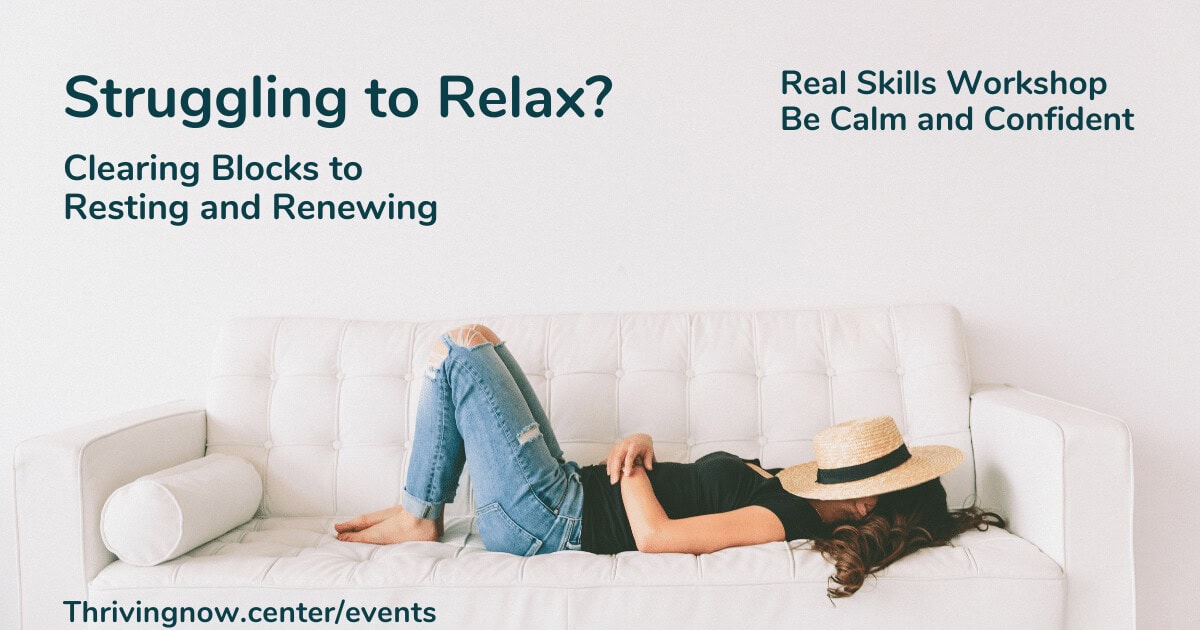
Questions, reflections, and real-life examples are welcome. Continue the conversation about Struggling to Relax? Clearing Blocks to Resting and Renewing in the Thriving Now Center.