
Transcript · Download MP3 · Download MP4
Invitation
Self-put-downs can be so constant that we experience them like a fish experiences water: not as messages, but as reality.
I am stupid. I talk too much. I cannot do anything right. No one wants me around. I am ugly, awkward, worthless, too old, too much. Some thoughts shout. Others move beneath awareness so quickly that we only notice the downstream effect: the mood suddenly tanks, the body braces, curiosity disappears.
We cannot simply command ourselves to stop. These pathways were often built for survival, status, and belonging. A child learns to silence their enthusiasm before an overwhelmed parent does. A bright person lowers their intelligence so others will not knock them down. Someone who has been treated as valueless may adopt worthlessness as protection from the full impact of what was done.
Putting ourselves down is an energetic downer. It reduces perceived threat—and it also hides the strength, intelligence, caring, and life force we need for thriving.
A Put-Down Is Often a Status Move
The primitive brain assesses hierarchy before conscious thought. Who has power? Where do I fit? What must I do to remain supported?
If respect your elders meant unquestioning obedience, an independent preference could threaten belonging. If speaking freely exhausted caregivers, I talk too much helped us suppress expression before they erupted. If being visibly smart attracted attack, I am stupid lowered our energetic profile.
This is why arguing with the content is often ineffective. The belief is not only a statement; it is a safety maneuver.
Ask:
- How does lowering myself help me fit or avoid being targeted?
- Whose tone did I internalize?
- What status did I have to maintain?
- What strength becomes less visible when I say this?
- Is that protection necessary in this place, with these people, now?
The goal is not to inflate ourselves above others. It is to step sideways out of the crude status game and into fit, values, and power-with.
Tapping: I Learned to Lower My Energy
Side of the Hand: Even though putting myself down helped me maintain a safer place in the hierarchy, that was a smart adaptation, and I want more choice about when and where I lower my energy now.
Top of the Head: My primitive brain tracks status fast.
Eyebrow: It learned who was allowed to be big or bright.
Side of the Eye: I silenced myself before they could.
Under the Eye: I called myself stupid before anyone else did.
Under the Nose: I learned not to get too big for my britches.
Chin: Lower energy may have meant less threat.
Collarbone: That strategy helped me survive a real environment.
Under the Arm: I respect the part that learned it so well.
Top of the Head: I can assess the actual space I am in now.
Eyebrow: I do not need one downer for every situation.
Side of the Eye: I can regulate without degrading myself.
Under the Eye: I can be quiet without calling my voice bad.
Under the Nose: I can be savvy without pretending I am stupid.
Chin: I can choose fit instead of ranking my worth.
Collarbone: My strengths do not require anyone else to be beneath me.
Under the Arm: I am learning the energy of calm confidence.
Take a breath. Notice whether your posture or inner volume changes when regulation is separated from humiliation.
Thoughts Are Impactful—and Not Automatically True
The sentence is in our head, so we assume it belongs to truth. Yet thoughts can be inherited recordings, trauma conclusions, marketing messages, and rapid guesses.
Culture deliberately activates status insecurity around youth, weight, beauty, clothing, money, and prestige. The people in advertisements often do not look like their altered images. We are invited to feel inadequate so we will spend to climb an impossible ladder.
Our own mind does something similar with other people’s faces. A stranger looks tense because they forgot an obligation; we decide the expression is about us. We project a criticism, then use our imagined version of their thought to beat ourselves.
Move from It is true to I am noticing a thought. Write it down. Say it aloud. Notice its age, tone, speed, and body effect. The sentence becomes something we can examine rather than invisible water.
Tapping: This Thought Feels Absolutely True
Side of the Hand: Even though this thought has repeated so often that it feels like a fact, repetition made the pathway fast; it did not make the verdict complete or divine.
Top of the Head: I am ugly, stupid, and not worth it.
Eyebrow: I am too old and I always fail.
Side of the Eye: Thank goodness someone finally understands me.
Under the Eye: I am very skilled at putting myself down.
Under the Nose: This thought has years of practice behind it.
Chin: It may be protecting me from something specific.
Collarbone: I do not have to pretend it vanished.
Under the Arm: I can notice it as a thought running through me.
Top of the Head: Other people’s thoughts can be mistaken.
Eyebrow: Their looks may not be about me at all.
Side of the Eye: My thoughts can also be partial or outdated.
Under the Eye: What if I am smart and silly in different moments?
Under the Nose: What if I am imperfect and still deeply caring?
Chin: My appearance is not the whole picture of my presence.
Collarbone: I wonder what else might be true here.
Under the Arm: One honest branch is enough to begin rewiring.
Take a breath. You do not need to believe a glowing opposite. Look for one additional truth the put-down excludes.
Interrupt the Bullet Train
Fast neural pathways need a pattern interruption before reflection is possible. Choose a safe word that is emotionally unrelated and slightly ridiculous: Aardvark. Say it the moment you catch the spin.
At first, the pause may last half a second. That is success. The purpose is not to suppress thought; it is to create a gap in automatic repetition.
Then do something undeniably specific:
- One plus one equals two. I got that right.
- Put one object where it belongs.
- Feel one foot and name three colors.
- Write the actual sentence on paper.
- Say, I am having a bad-head moment and the old train is moving fast.
Global statements rely on perfect wrongness. I cannot do anything right is disproved by reconnecting a dropped call, reading a sentence, or drawing a gloriously weird aardvark. Silly specificity returns us to reality.
The pattern matters physically. Repeated threat thoughts release stress chemistry and hold muscular tension. Changing them is not vanity. Even a modest reduction frees energy for healing, relationship, play, and useful action.
Tapping: I Cannot Do Anything Right
Side of the Hand: Even though “I cannot do anything right” is my perfect statement of perfect wrongness, I hear the suffering and alarm inside it, and I am willing to interrupt the absolute.
Top of the Head: I still cannot do anything right.
Eyebrow: Anything. Ever. Not one thing.
Side of the Eye: My primitive brain loves a blanket statement.
Under the Eye: It makes the whole world one familiar verdict.
Under the Nose: Aardvark.
Chin: One plus one equals two.
Collarbone: I just did one tiny thing accurately.
Under the Arm: The absolute has a crack in it.
Top of the Head: I do some things awkwardly.
Eyebrow: I make mistakes and sometimes repair them.
Side of the Eye: I also reconnect, learn, contribute, and care.
Under the Eye: I can name one thing instead of condemning everything.
Under the Nose: Specific information can guide me.
Chin: Global punishment cannot.
Collarbone: My brain wants to heal when I give it a pathway.
Under the Arm: One small accurate statement gives my body room.
Take a breath. Name one ordinary thing you did sufficiently, even if the critic calls it too small to count.
Hidden Strengths Live Under the Put-Down
If I am stupid has been suppressing intelligence, reducing it by five percent may reveal curiosity and original perception. If I talk too much has constrained expression, a small shift may uncover storytelling, teaching, humor, advocacy, or relational warmth.
If I am too much appears, become contextual: My energy was too much for those people, in that room, at that moment. That is different from making your existence wrong. We can perceive that a space cannot hold our full dance, regulate our expression, and seek places with more room—without popping an energetic downer.
Sometimes we were a kitten raised by ducks. The family kept urging us to swim while our nature wanted to climb. Their failure to recognize us did not make us defective. It meant the original ecosystem was not equipped to reflect our kind of value.
Fit is different from status. We need not be interesting to everyone or win the hierarchy. We need enough access to our values and strengths to recognize the people and places where power-with becomes possible.
When Worthlessness Was Protection
For someone who endured abuse, I have no value may have reduced unbearable impact. If the harmed self was “worthless,” the primitive brain could distance from the truth that a precious person was being violated.
Do not rip away this defense with You are valuable! Work gently with the younger self who created it:
That was intelligent protection. You did not cause what happened. We can discover safety for value now in tiny increments.
Strength may first appear as the capacity to survive, notice, seek help, or remain tender. Trauma-focused support may be appropriate. The aim is not to make worth another performance requirement.
Tapping: Is It Safe to Have Value Now?
Side of the Hand: Even though feeling worthless may have protected me from the full pain of how I was treated, I honor that brilliant younger strategy, and I will not force value onto the part that still associates it with danger.
Top of the Head: It was safer to believe I was nothing.
Eyebrow: Then what happened was happening to someone without value.
Side of the Eye: The alternative may have been too painful to hold.
Under the Eye: Younger me found a way to survive.
Under the Nose: I will not shame that protection.
Chin: I do not have to become precious all at once.
Collarbone: I can begin with being here.
Under the Arm: Existing through it required something powerful.
Top of the Head: Is there one value I know matters to me?
Eyebrow: Honesty, kindness, freedom, consent, or care?
Side of the Eye: I can value the value before I value all of me.
Under the Eye: I can notice one person who receives something I offer.
Under the Nose: I can choose safer mirrors and smaller steps.
Chin: Having value now does not cause the old event.
Collarbone: I can let one tendril of worth grow with protection.
Under the Arm: My pace belongs to me.
Take a breath. Let value mean aliveness, preference, or one cherished principle—not a demand to feel magnificent.
Reality-Check with Safe People
Shame predicts other people’s judgments. Instead of spinning alone, ask a trusted person for reality:
I am worried I am talking too much. Would you tell me honestly how it is for you?
The answer may be yes, no, or nuanced. Reality is workable. Projection is endless.
We can also ask for supportive evidence on a low-mood day: Would you tell me three ways I have added to your life? This is not outsourcing all worth. It gives the brain data it has been trained to filter out.
Likewise, when someone does not see our worth, we can notice the mismatch rather than converting it into universal truth. We do not need to invest deeply in every person. There are billions we have not met, and some will resonate with the qualities our first ecosystem missed.
Practices for Living This Skill
- Catch the exact sentence. Write the words and punctuation without cleaning them up.
- Use a pattern-interrupt word. Practice it when calm so it is available when the neural train speeds up.
- Translate absolutes. Replace anything, nobody, always, and worthless with the specific task, person, time, or condition.
- Ask what status move is happening. Notice whether you are lowering yourself, elevating someone else, or avoiding visibility.
- Name the hidden strength. What becomes less threatening when you suppress intelligence, energy, beauty, leadership, sensitivity, or desire?
- Reduce rather than eradicate. Aim for five percent less self-attack and notice what energy becomes available.
- Check the timestamp. Ask when you learned this and what choices your present self has that the younger self did not.
- Ask for reality. Use consent-based feedback with a trustworthy person instead of mind-reading.
- Find fit. Move toward people and spaces organized around shared values, not only rank or appearance.
- Protect gentle trauma work. When a put-down carries abuse or profound shame, use tolerable increments and appropriate support.
Bringing It Into Your Life
We may never remove every primitive comparison or harsh thought. The goal is not perfect niceness toward ourselves. That would give perfectionism another weapon.
The skill is noticing sooner, interrupting the automatic downer, appreciating its protective history, and returning to specific reality. Each interruption reduces stress and reveals a little more capacity.
Under the put-down may be a voice, a curious mind, a tender heart, a nonstandard rhythm, a gift that did not fit the first room, or simply more energy to be present with life.
Aardvark. Pause the train. Get specific. Let one hidden strength stand up without putting anyone else down.
Continue the Conversation
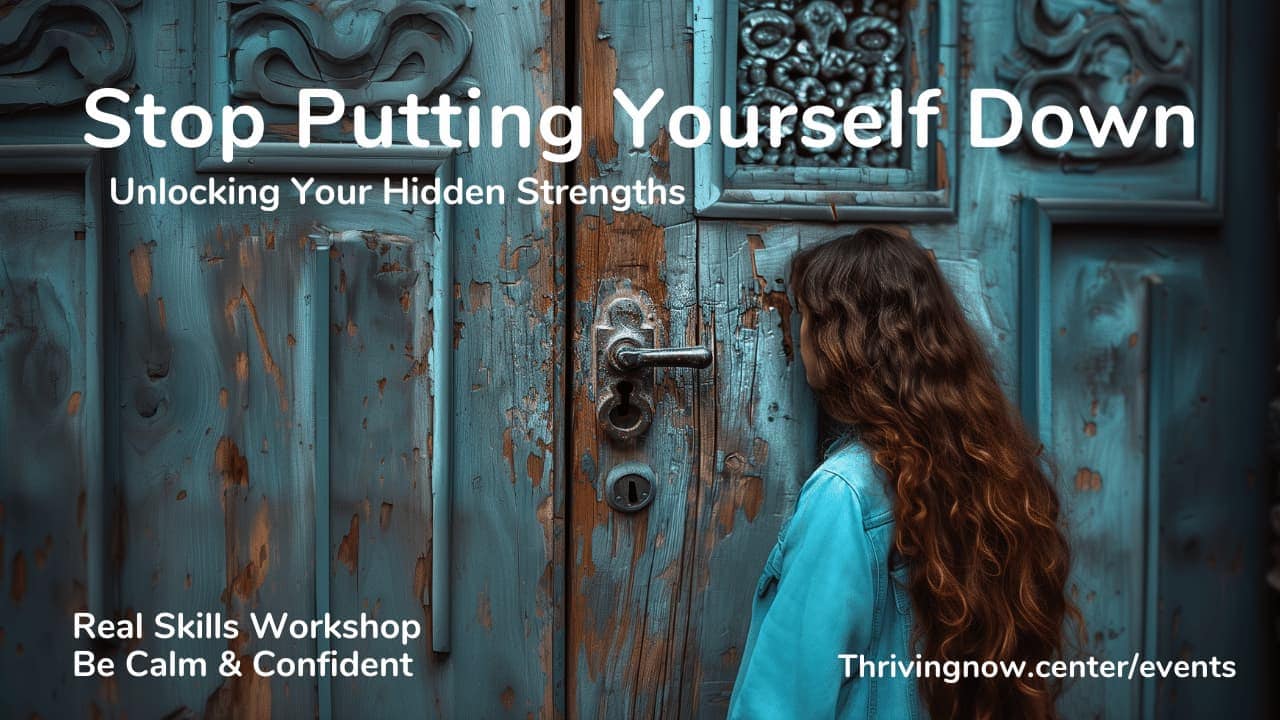
Questions, reflections, and real-life examples are welcome. Continue the conversation about Stop Putting Yourself Down — Unlocking Your Hidden Strengths in the Thriving Now Center.