
Transcript · Download MP3 · Download MP4
Invitation
Life is unknown and uncontrollable. That does not mean we cannot influence, pause, respond, co-create, or even fly when support arrives.
Practical improv expands our options beyond automatic fight, flight, freeze, and fawn. It brings awareness inside and outside, accepts what is here, and lets the next response emerge. Play is core—but it need not be silly, cheerful, or forced.
“Yes… and…” means accepting this moment enough to participate in what comes next.
Accept What Is Without Calling It What You Want
The yes of improv says: This is what is present. It is not approval, consent, or resignation. The and asks: Given this, what wants to move, pause, protect, connect, or be created?
Perfectionism claims that proper preparation should prevent bad things and make life go our way. Improv expects the field to change. Preparation becomes a resource, not a guarantee.
Tapping: I Want to Be in Control
Side of the Hand: Even though I believed enough preparation and skill would keep bad things from happening, life keeps changing the scene.
Even though not controlling the outcome frightens my primitive brain, uncertainty does not erase all influence.
Even though I cannot script every response, I can practice staying in relationship with what is actually here.
Top of the Head: I want to be in control.
Eyebrow: I want the plan to guarantee the outcome.
Side of the Eye: Surprise feels like proof I failed.
Under the Eye: My primitive brain has only a few moves.
Under the Nose: Push harder, run, freeze, or please.
Chin: Those moves helped me survive.
Collarbone: They are not the whole palette.
Under the Arm: I can make room for another response.
Top of the Head: Yes, this is what is here now.
Eyebrow: And I can feel for what comes next.
Side of the Eye: Pause may be an action.
Under the Eye: Curiosity may open another path.
Under the Nose: Support may change what is possible.
Chin: Attraction and repulsion both contain information.
Collarbone: I can respond without knowing the ending.
Under the Arm: I am practicing influence without control.
Include the Gap
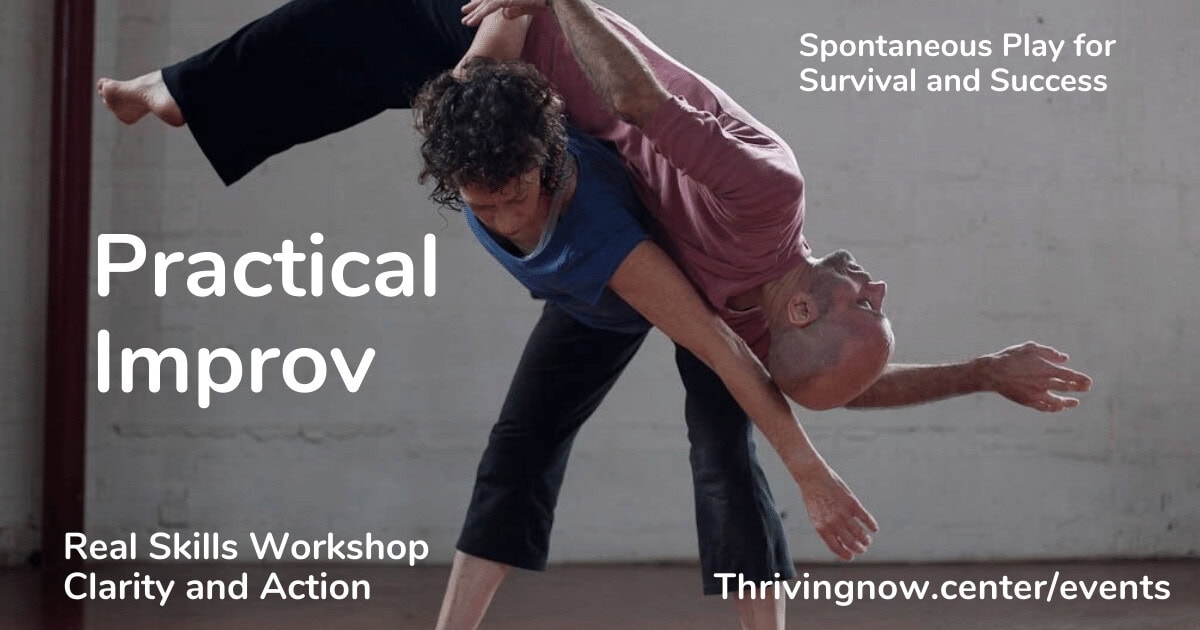
In contact improv, the gap is where what was has ended and what comes next has not formed. The primitive brain rushes to fill it. Practical improv builds capacity to remain there—with attention, breath, curiosity, and choice.
Inner awareness and outer awareness alternate: What do I notice in me? What is happening in the environment or between us? What changes when I move? Then we listen again.
Let Attraction and Repulsion Inform Movement
The body may lean toward, draw back, soften, brace, become curious, or want more distance. These are not absolute commands, yet they are valuable signals. A tiny movement toward or away can reveal more than prolonged analysis.
Improv includes exits and boundaries. “Yes, this is happening” can be followed by “and I am leaving,” “and I need less weight,” or “and I am not available for this dance.”
Tapping: The Gap Feels Dangerous
Side of the Hand: Even though the gap feels like nothing is holding me, it may be a living space between an old move and a new one.
Even though I want to fill it with the familiar groove, I can stay for one breath without taking away my right to act.
Even though I may feel attraction, repulsion, confusion, or blankness, each can be information rather than a verdict.
Top of the Head: I do not know what comes next.
Eyebrow: The old groove is ready to take over.
Side of the Eye: Familiar does feel safer.
Under the Eye: Even when it keeps repeating the pain.
Under the Nose: I can pause for one small beat.
Chin: What do I notice inside?
Collarbone: What do I notice outside and between?
Under the Arm: What movement feels honest now?
Top of the Head: I can lean a millimeter toward or away.
Eyebrow: I can stop, ask, or change the rhythm.
Side of the Eye: I can protect myself and stay creative.
Under the Eye: I can choose right distance and right depth.
Under the Nose: I do not owe the scene my self-abandonment.
Chin: The gap can hold curiosity.
Collarbone: My next move can arise from contact.
Under the Arm: I am more than my automatic pathway.
Add Choice Without Taking Away Comfort
When we are triggered, an old comfort—food, television, a familiar chair, withdrawal—may be the pathway our body trusts. Shame and abrupt removal can intensify the emergency.
Improv asks what can be added: eat the comfort food with attention; use a special bowl; sit somewhere different; walk once around the couch; ask someone to be present; warm it, slow it, or pair it with another source of nourishment.
The point is not novelty for novelty’s sake. A small variation tells the nervous system: I have more than one possible move.
Tapping: Do Not Take Away What Comforts Me
Side of the Hand: Even though this familiar comfort has helped me survive hard moments, I will not shame myself or rip it away.
Even though part of me fears that change means losing the only thing that works, improv can add support rather than demand deprivation.
Even though I may not be ready for a big change, one gentle variation can restore a little authorship.
Top of the Head: Do not take away my comfort.
Eyebrow: This groove has carried me before.
Side of the Eye: I need my body to trust me.
Under the Eye: Comfort is not a moral failure.
Under the Nose: I can enjoy what is actually soothing.
Chin: I can notice when enough feels complete.
Collarbone: I can ask what else would support me.
Under the Arm: Addition may feel safer than removal.
Top of the Head: What tiny variation feels possible?
Eyebrow: A different place, pace, hand, bowl, or companion.
Side of the Eye: A lap around the couch still counts.
Under the Eye: A clear request for nurturing can count.
Under the Nose: I can play without performing playfulness.
Chin: I can respect the seriousness of my need.
Collarbone: More pathways create more freedom.
Under the Arm: Yes to comfort—and to growing choice.
Practices for Living This Skill
Use “Yes… and…” accurately
Name present reality, then add an honest movement—not a forced positive ending.
Practice in low-stakes moments
Change a route, seat, sequence, rhythm, or ordinary choice so novelty becomes less threatening.
Track inside and outside
Alternate attention between body signals and the actual environment.
Stay in the gap for one breath
Do not demand an inspired answer. Simply interrupt automatic continuation.
Add before subtracting
Bring awareness, beauty, movement, support, or choice to a trusted comfort.
Keep exits in the palette
Spontaneity without consent or safety is not the skill being practiced here.
Bringing It Into Your Life
Improv is not abandoning structure. Choreography, agreements, and preparation can be part of the dance. The skill is noticing that today’s body, weather, relationship, and resources are not yesterday’s.
Playfulness keeps the field alive, but sacred or difficult moments do not need jokes. Sometimes the most creative move is a wholehearted pause.
We are not in control. We are still participants.
Yes to what is. And to the next living possibility.
Continue the Conversation
Questions, reflections, and real-life examples are welcome. Continue the conversation about Practical Improv – Spontaneous Play for Survival and Success in the Thriving Now Center.