
Transcript · Download MP3 · Download MP4
Invitation
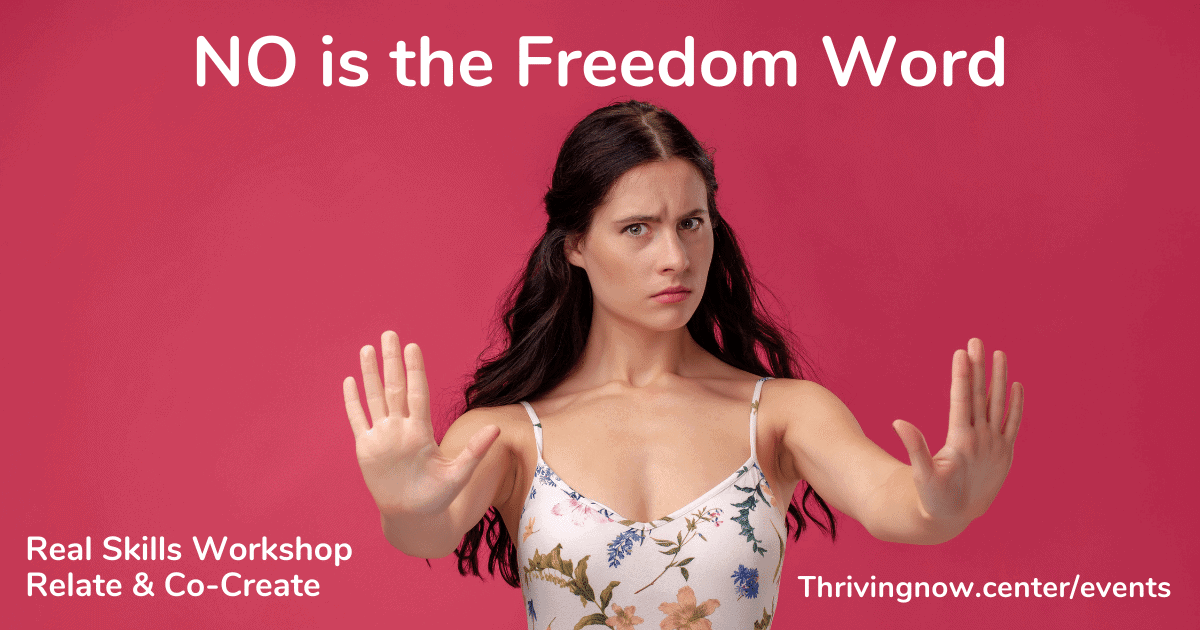
Saying no is complicated.
It is only two letters, yet it can activate memories of punishment, rejection, coercion, disappointed faces, lost belonging, and times when no did not stop what was happening. Some of us learned to hint, explain, appease, disappear, or stop noticing what we wanted because knowing our no seemed useless or dangerous.
Without a believable no, we can feel trapped even while appearing agreeable. We may live from obligation, silently accumulate resentment, or offer yeses that do not include us.
If we do not have a no, we do not have a meaningful yes.
No is the freedom word because it restores choice. It lets us recognize our truth, tend our life force, and discover what we can wholeheartedly offer instead.
Begin With the No Inside You
Speaking a no is not always the first step. For people whose boundaries were ignored, even knowing that something is unwanted can feel risky.
The first freedom is internal:
- This is a no in my body.
- I do not want this, even if I choose to do it.
- I need more time before I answer.
- I am not available for that form, time, place, or intensity.
This clarity matters even when the outer situation is constrained. You may decide that complying is the safest or most values-aligned choice. You may choose a difficult medical procedure, pay a bill, keep a promise, or help someone you love at an inconvenient hour. The skill is not pretending you love every option. It is recognizing that I have to and this matters enough that I choose it create very different inner postures.
No tells the truth about what is unwanted. Choice lets us decide what we will do with that truth.
The Consequences Are Real
Freedom does not mean that every no will be welcomed. A friend may feel disappointed. An invitation may not come again. A professional may enforce a cancellation agreement. A controlling person may punish, pressure, or withdraw.
It is emotionally bypassing to promise that a clear no has no consequences. The more useful comparison is broader:
- What might happen if I say no?
- What happens to me if I never say no?
- Which consequences can I repair, tolerate, negotiate, or protect myself from?
- Which relationship reveals itself as unsafe when my no appears?
Never finding yourself is also a consequence. So is a life built from resentful yeses.
Tapping: When No Once Meant Danger
This round honors the intelligence that learned silence, compliance, or concealment. Do not use it to pressure yourself into confronting someone unsafe. If saying no could bring physical danger, prioritize specialized support, practical safety, and distance where possible.
Side of the Hand: Even though they would not tolerate my no, my body learned something important about survival, and I respect why this still feels dangerous.
Even though no brought punishment, abandonment, rage, or having to do it anyway, I am not foolish for remembering those consequences.
Even though part of me still says, No, no, no—do not let them know, I am open to finding a little more choice in the life I have now.
Top of the Head: There was no room for my no.
Eyebrow: They did not want me to be that free.
Side of the Eye: My body remembers the consequences.
Under the Eye: It learned to appease, hide, or go silent.
Under the Nose: Sometimes no really was dangerous.
Chin: I will not shame the wisdom that protected me.
Collarbone: I can honor what was true back then.
Under the Arm: Without declaring that every situation is the same now.
Top of the Head: I notice the echo: No means danger.
Eyebrow: How true is that with this person, here and now?
Side of the Eye: Maybe it is still unsafe with some people.
Under the Eye: Their lack of safety is useful information.
Under the Nose: Maybe other people can hear and respect me.
Chin: I can practice where the stakes are smaller.
Collarbone: I can build support, language, exits, and distance.
Under the Arm: My adult life may contain possibilities I did not have then.
Top of the Head: I want access to my no inside me.
Eyebrow: Even before I decide what to say or do.
Side of the Eye: I can recognize what is not right for me.
Under the Eye: I can pause before abandoning myself.
Under the Nose: I can protect myself without calling myself powerless.
Chin: I am learning who is safe to practice with.
Collarbone: My no belongs in my emotional vocabulary.
Under the Arm: One honest branch point at a time.
Take a breath. Look at your present surroundings and notice what belongs to then, what belongs to now, and what support would make your next step safer.
No Opens the Landscape
When the nervous system believes I cannot say no, it tends to search for escape rather than possibility. Once no is imaginable, creativity can return.
A useful doorway is:
That is a no for me. What might be a yes is…
Perhaps you are a no to the restaurant and a yes to sandwiches at home. A no to staying awake until the delayed train arrives and a yes to paying for a ride. A no to the original deadline and a yes to a smaller deliverable. A no to discussing something now and a yes to returning tomorrow.
Sometimes the yes is to rest, leave, end the relationship, pay the consequence, or keep the reason private. The purpose is not to sweeten every no for someone else’s comfort. It is to let your life force orient toward what you are choosing.
A Request Must Be Allowed to Meet No
Enthusiasm, seduction, persuasion, and problem-solving are not automatically harmful. They become coercive when the other person’s no is treated as an obstacle to defeat.
There is a meaningful difference between:
- Would you be open to exploring another option?
- Come on. I did this for you. You owe me.
Consent-aware exploration checks whether negotiation itself is welcome. It cares about both people and the relationship between them. Cajoling keeps pushing because one person’s desired outcome matters more than the other’s freedom.
When a no concerns touch, sex, health, safety, or another vulnerable edge, clarity matters even more. If people enjoy playful resistance or power exchange, they need explicit agreements and an unmistakable stop word whose meaning is honored immediately.
A no that is repeatedly negotiated is not being received as a no.
Tapping: Their Disappointment Feels Like My Emergency
Someone can be disappointed and still be okay. You can care about their feelings without reversing your boundary or making their reaction proof that you are selfish.
Side of the Hand: Even though their disappointment lands like an emergency in my body, I can care about them without automatically changing my answer.
Even though I learned that a good person prevents everyone else’s upset, their feelings and my freedom both deserve a place.
Even though part of me wants to explain until they approve of my no, I am open to letting clarity be enough.
Top of the Head: They might be disappointed.
Eyebrow: They might pull away.
Side of the Eye: They might think I am selfish.
Under the Eye: My primitive brain calls that dangerous.
Under the Nose: It wants me to fix their feeling.
Chin: It wants a reason they cannot argue with.
Collarbone: No wonder I overexplain.
Under the Arm: No wonder a simple no feels exposed.
Top of the Head: Their feeling is real.
Eyebrow: And it is not automatically my command.
Side of the Eye: I can say, I hear that you are disappointed.
Under the Eye: Listening does not reopen negotiation.
Under the Nose: Caring does not require self-abandonment.
Chin: They are allowed their reaction.
Collarbone: I am allowed my choice.
Under the Arm: A sturdy relationship can contain both.
Top of the Head: I want my no to protect generous yeses.
Eyebrow: I can offer what is honestly available.
Side of the Eye: I can stop making promises from panic.
Under the Eye: I can repair when repair is appropriate.
Under the Nose: I can create distance when pressure is the pattern.
Chin: Their response teaches me about the relationship.
Collarbone: My clarity teaches people how to navigate me.
Under the Arm: I am building relationships where freedom belongs.
Take a breath and imagine the other person having their feelings without either of you disappearing.
Hearing No Is Part of the Skill
We may long to say no freely while still finding another person’s no intolerable. It can register as rejection, disloyalty, loss of status, or evidence that the relationship is failing.
Yet being trusted with a real no is a threshold of intimacy. Until someone can decline something that matters to us, we do not fully know whether their yes is free.
Receiving no cleanly can sound like:
- Thank you for telling me.
- I am disappointed, and I want you to take care of yourself.
- Is the no complete, or are you open to another form?
- I care about our relationship more than getting this particular answer.
No does not prohibit honest feeling. It prohibits making our feeling into pressure the other person must relieve.
Tapping: When Their No Feels Like Rejection
Side of the Hand: Even though their no touches the part of me that fears I do not matter, I can notice that hurt without turning it into control.
Even though I wanted their yes—maybe very much—I want relationships where both of us are real.
Even though disappointment is uncomfortable, I am open to letting it move without punishing them or shaming myself.
Top of the Head: I did not want to hear no.
Eyebrow: Part of me hears, You are not wanted.
Side of the Eye: Part of me wants to persuade, pout, or withdraw.
Under the Eye: I can feel the hurt underneath that impulse.
Under the Nose: Their no may be about capacity, timing, or preference.
Chin: It is not a verdict on my worth.
Collarbone: And even if the relationship is changing, I can face reality.
Under the Arm: Without demanding a counterfeit yes.
Top of the Head: I want the people I love to have freedom.
Eyebrow: I want their yes to include their whole self.
Side of the Eye: Their no gives me useful information.
Under the Eye: We can explore only if exploration is welcome.
Under the Nose: I can find another person, time, or form.
Chin: I can tend my disappointment with dignity.
Collarbone: Their self-care and mine can both belong.
Under the Arm: A clear no protects the field where wholehearted yes can grow.
Notice whether the no feels even slightly less like annihilation and more like information you can live with.
Say Less When Less Is True
No can be a complete sentence. Explanations are optional.
When we offer a problem as our reason—My car is unreliable—someone may solve it—Use mine—and leave us more trapped. If you are open to negotiation, share the condition that would create a yes. If you are not, clarity is kinder:
- No, that does not work for me.
- I felt into it, and I am a no.
- I love spending time with you; this particular invitation is not a yes.
- That is personal, and I am not discussing it.
- My yes is to stay home, and it is not open for negotiation.
With longstanding relationships, context may help: I grew up without much access to no. I am practicing. If I decline something, encouragement would help me trust our relationship.
Practices for Living This Skill
Notice one body no
Do not act on it immediately. Simply let yourself know what is true before choosing.
Practice where it is safe and slightly silly
Say no to your mirror, a pet, or an absurd request from a trusted friend. Let the mouth and body learn the shape of the word without a high-stakes consequence.
Add a pause before answering
Try: I hear your enthusiasm. I need a moment to feel what is true for me.
Turn a no toward a chosen yes
Ask: If that is not right for me, what form, timing, distance, or next step might be?
Pre-frame freedom
When making a request, add: Please feel free to say no. Then mean it.
Learn people’s change-of-plan agreements
Ask what works if capacity changes. Clear agreements make consequences understandable without turning boundaries into punishment.
Map safe practice partners
Begin with people who value autonomy and repair. People who punish every no are information—not advanced practice assignments.
Let one no remain unexplained
Notice the urge to justify. Breathe. See whether That does not work for me can stand.
Bringing It Into Your Life
The goal is not to become a person who says no reflexively. It is to become someone who can recognize no, hear no, protect no, and let no reveal the yes that carries life.
Some noes will be easy. Some will remain sticky and icky. Some will ask for safety planning, support, distance, repair, or a consequence you consciously accept. Each time you stop treating your truth as inadmissible, you strengthen freedom.
We are not practicing no so that no one ever feels disappointed. We are practicing so that our relationships can include our true YES, too.
Know the no. Find the yes. Let freedom make consent real.
Continue the Conversation
Questions, reflections, and real-life examples are welcome. Continue the conversation about NO is the Freedom Word in the Thriving Now Center.