
Transcript · Download MP3 · Download MP4
Invitation
Hope is often presented as a mood we should generate: think positively, believe everything will work out, and do not dwell on darkness.
For a nervous system shaped by abuse, repeated disappointment, or promises that never came true, that kind of optimism can feel dangerous or insulting. Expecting less may have reduced the shock.
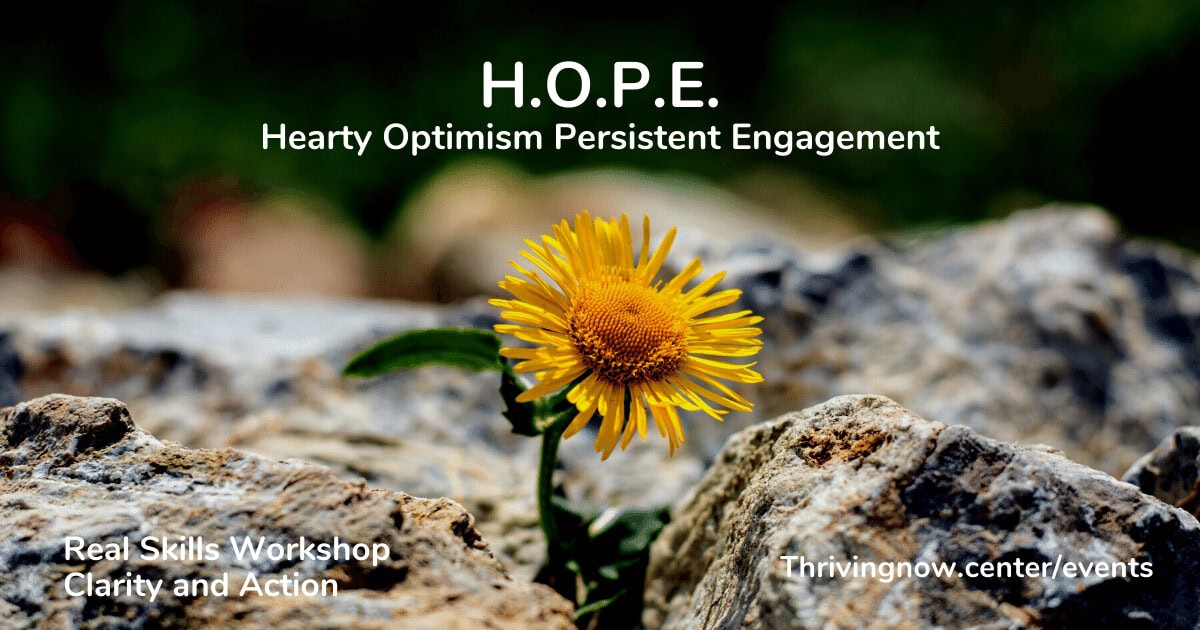
H.O.P.E. offers another path: Hearty Optimism, Persistent Engagement. Not certainty that we will get the outcome we want, but a heart-supported willingness to keep participating in what matters.
Hearty Optimism Is Not a Guarantee
Optimism can be brittle when it depends on a particular result. Hearty optimism includes reality, grief, risk, and our capacity to adapt.
It says:
- Something meaningful may still be possible.
- I may not see the route yet.
- Support, skill, timing, and surprise can change the field.
- If this attempt fails, I may learn or choose again.
This is closer to optimalism than idealism: seeking the most life-serving engagement available in actual conditions.
Tapping: Hope Has Hurt Me Before
Side of the Hand: Even though hoping made disappointment more painful, I respect why part of me learned not to expect anything good.
Even though promises were broken and effort did not always matter, I do not want false hope pasted over those truths.
Even though certainty is unavailable, perhaps I can allow one small possibility without betting my whole heart on it.
Top of the Head: Hope has hurt me before.
Eyebrow: I believed them and they failed me.
Side of the Eye: I tried and nothing changed.
Under the Eye: Expecting less felt safer.
Under the Nose: No wonder optimism creates resistance.
Chin: I do not need to guarantee the outcome.
Collarbone: I can make room for one possibility.
Under the Arm: My heart can stay protected and still breathe.
Top of the Head: Maybe is enough for now.
Eyebrow: One opening, not a grand promise.
Side of the Eye: I can gather present evidence.
Under the Eye: I can choose a step with an exit.
Under the Nose: I can adjust if reality changes.
Chin: Hope can become flexible rather than fragile.
Collarbone: I am allowed to want without demanding certainty.
Under the Arm: A little light can coexist with honest darkness.
Persistent Engagement Can Be Tiny
Persistence is not grinding without rest. It is returning.
We may engage for seven minutes, pause for a week, ask for help, change methods, or decide the deeper value needs a different form. A small repeatable contact with what matters can be more persistent than one heroic effort followed by collapse.
The primitive brain may reject small engagement because it does not end the pain. Yet each return says: This matters. I have not abandoned it—or myself.
Borrow Light When You Cannot Generate It
Some areas are too dark for solo optimism. We can borrow another person’s steadiness without requiring them to promise that everything will be fine.
A hope-holder might say:
I believe there may be possibilities you cannot see from inside this pain. I will sit with you while we look—or while we simply endure this hour.
Borrowed hope is not dependency or persuasion. It is co-regulation and expanded perspective. Choose people who can acknowledge reality rather than rush you toward brightness.
Tapping: I Cannot Find Any Light Here
Side of the Hand: Even though this area feels completely dark, I will not shame myself for being unable to manufacture light.
Even though part of me has stopped looking, that may be exhaustion rather than a final truth about what is possible.
Even though I cannot hold hope alone right now, I may be willing to let someone trustworthy hold a small candle nearby.
Top of the Head: I cannot see a way.
Eyebrow: I am tired of searching.
Side of the Eye: Positivity feels cruel here.
Under the Eye: This darkness deserves honest company.
Under the Nose: I do not have to brighten it on command.
Chin: I can ask for presence instead of promises.
Collarbone: Someone else may see an option later.
Under the Arm: I can borrow steadiness without pretending.
Top of the Head: The candle can be outside me for now.
Eyebrow: I am not failing at hope.
Side of the Eye: My system may be conserving what remains.
Under the Eye: Rest can be part of persistent engagement.
Under the Nose: Receiving support is an action.
Chin: Staying through this hour can be an action.
Collarbone: I leave one door unlocked to possibility.
Under the Arm: That is enough hope for this moment.
Let Failure Refine Engagement
Expected failure can stop us before contact. Or it can make us overwork, trying to force success so the old prophecy cannot come true.
Hearty engagement asks smaller questions:
- What did this attempt reveal?
- Was the method, timing, support, scale, or goal mismatched?
- What value beneath the goal still matters?
- Is another attempt alive—or is release the hopeful act?
Persistence serves a value, not an inflexible strategy. We can remain devoted to connection while leaving a harmful relationship, to creativity while abandoning one project, or to health while changing what improvement means.
Tapping: If I Cannot Win, Why Engage?
Side of the Hand: Even though I may not succeed in the form I imagined, engagement can still give me information, dignity, skill, or a new direction.
Even though I hate wasting effort, refusing every uncertain step also has a cost.
Even though I may need to release this strategy, I can remain loyal to the deeper value.
Top of the Head: What if I fail again?
Eyebrow: I do not want more evidence against me.
Side of the Eye: My system wants a guaranteed win.
Under the Eye: Life rarely offers that.
Under the Nose: I can choose a survivable experiment.
Chin: I can define what I want to learn.
Collarbone: I can stop if the cost becomes wrong.
Under the Arm: Choice makes engagement different from captivity.
Top of the Head: My value is larger than one outcome.
Eyebrow: I can adapt the form.
Side of the Eye: I can celebrate contact, not only completion.
Under the Eye: I can rest and return.
Under the Nose: I can let new information matter.
Chin: I can release what no longer serves.
Collarbone: This is persistent, living engagement.
Under the Arm: My heart can remain involved without being enslaved.
Practices for Living This Skill
Use possibility language
Try maybe, not yet visible, and one possible opening instead of guaranteed optimism.
Choose a survivable experiment
Limit time, money, exposure, or emotional stakes while gathering real information.
Name the deeper value
Separate what matters from the single outcome or strategy.
Borrow hope with consent
Ask a trusted person to hold possibility without minimizing your pain.
Let rest count
Persistent engagement includes restoration, pauses, and metabolizing disappointment.
Track returns
Notice each time you come back to a value after fear, fatigue, or failure.
Release with heart
Sometimes ending a method, dream, or relationship protects the life the hope was meant to serve.
Bringing It Into Your Life
Hope will flicker. Some possibilities will close. We will sometimes confuse persistence with pushing or optimism with denial.
H.O.P.E. is not something we either possess or lack. It is a practice of staying in relationship with life—sometimes brightly, sometimes by borrowed candlelight, sometimes through rest.
Hearty enough for reality. Optimistic enough for possibility. Persistent enough to return. Engaged enough to learn.
No guarantees. Still, a living next step.
Continue the Conversation
Questions, reflections, and real-life examples are welcome. Continue the conversation about H.O.P.E. – Hearty Optimism Persistent Engagement in the Thriving Now Center.