
Transcript · Download MP3 · Download MP4
Invitation
Do you want a hug?
At a gathering devoted to cuddling, the question might seem unnecessary. Yet when open arms are paired with a genuine welcome for no, the hug becomes different. It is not merely implied by the setting. Both bodies are a yes now.
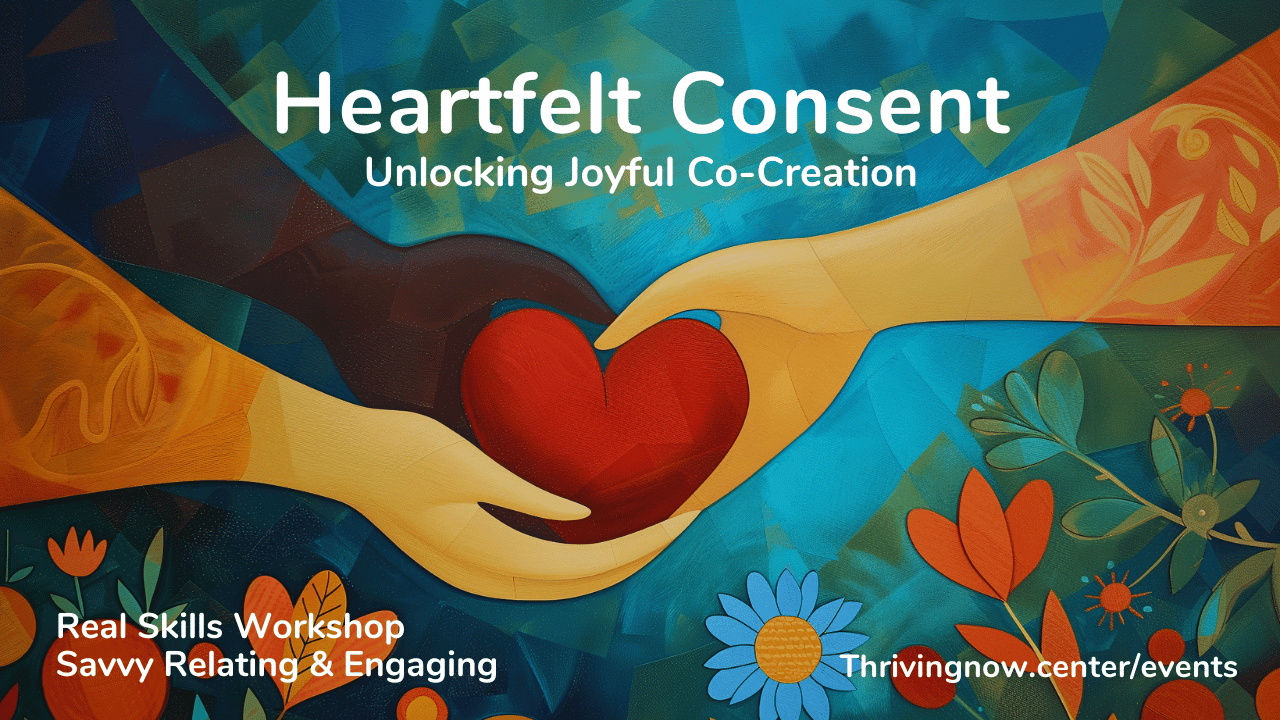
Heartfelt consent is more than permission. It moves us from power-over—whoever is strongest, guilts best, or has the most authority gets their way—toward power-with: two or more people finding what is true, wanted, and alive enough to co-create.
This does not apply only to touch or sexuality. It shapes chores, money, food, friendship, parenting, grief, work, and every request where yes and no are meant to have meaning.
Consent frees the heart from guessing. When we know another person chose what is happening, gratitude, trust, play, and joyful improvisation have room to grow.
Coping Together Is Not the Same as Co-Creating
Many relationships trade one tolerable outcome for another. One person pushes; the other complies. Resentment accumulates beneath an apparent agreement.
A consent conversation asks for a yes-yes: not necessarily everyone’s first preference, but an arrangement each person can own.
Useful questions include:
- What makes this a yes for you?
- Which part appeals to you?
- What would make this even better?
- What does that look like in your mind?
- If this is a no, are you open to exploring another possibility?
Words can conceal different pictures. “Hang out by the blue pool” may mean a resort-like backyard to one person and a plastic kiddie pool to another. Clarifying the picture is part of the play.
Consent Requires Choice—and Choice Includes Risk
If we ask, the other person may say no. If we say no, they may feel disappointed. If we change our mind, plans may need repair.
That uncertainty is why guilt, obligation, hinting, overgiving, and passive aggression become substitutes. Someone who never learned to ask directly may know no other way to signal a need.
Understanding the pattern does not require compliance. It helps us respond without making the person a monster or surrendering our own adulthood.
Tapping: Getting My Voice and Preferences Back
Side of the Hand: Even though consent feels awkward and my survival brain is scared I will mess it up, when I was little it could feel life-or-death to keep powerful people happy. Now I am grown, and I am learning new skills.
Top of the Head: I do not yet have all the skills I want.
Eyebrow: And I am pretty smart.
Side of the Eye: I can learn with safe, savvy people.
Under the Eye: Some of this feels really scary.
Under the Nose: I can take it in baby steps.
Chin: My primitive brain says I cannot ask for what I want.
Collarbone: It says I cannot say no.
Under the Arm: It says one wrong answer could cost connection.
Top of the Head: I was not born knowing how to tap or name feelings.
Eyebrow: Yet here I am learning both.
Side of the Eye: What if I can learn consent too?
Under the Eye: What if I can get my own voice back?
Under the Nose: I can become curious about my preferences.
Chin: I can ask for small things.
Collarbone: I can choose practice partners carefully.
Under the Arm: Awkward is allowed while new pathways form.
No Must Be Real for Yes to Be Trustworthy
No is a complete sentence. Explaining can accidentally turn a boundary into a puzzle for the asker to solve: My car is unavailable invites Take mine.
You may still add warmth when it is genuinely yours:
You matter to me. That is not a yes for me. I do not loan money. Would you like to brainstorm other options?
The explanation is not courtroom evidence. It expresses care while leaving the no intact.
Hearing no is the companion skill. A primal sting may arise, especially if asking was punished or ridiculed in the past. The direction we want is: They are caring for themselves. I want people whose yes and no are reliable.
People may feel hurt, angry, or disappointed. Their feeling is not proof your no was wrong. With enough safety, you can be present with disappointment without changing the answer.
Tapping: Their Disappointment Is Not a Consent Emergency
Side of the Hand: Even though part of me believes everyone must be happy with my choices, disappointment is a human feeling, not automatic proof that I harmed someone.
Top of the Head: They may not like my answer.
Eyebrow: My whole body tightens around that.
Side of the Eye: I learned to fix powerful people’s feelings.
Under the Eye: Their distress once affected my safety.
Under the Nose: No wonder this feels urgent.
Chin: I am not that powerless child now.
Collarbone: They can be disappointed and still be okay.
Under the Arm: I can care without reversing my no.
Top of the Head: I do not need to apologize for their feeling.
Eyebrow: I can say, “It looks like you’re disappointed.”
Side of the Eye: I can listen if I have capacity.
Under the Eye: Listening does not reopen negotiation.
Under the Nose: People who punish every no are not safe practice partners.
Chin: Clear no protects generous yes.
Collarbone: I want relationships sturdy enough for different feelings.
Under the Arm: Their self-care and mine can both belong.
Ask Clearly—or Be Honest That It Is Not Optional
Softening can hide a request beneath apology: Maybe sometime it might be nice… Clearer is kinder:
I would really like Chinese tonight. Would you like to go with me? Please feel free to say no.
If no is not currently an acceptable answer, do not disguise a requirement as a question. A parent can say: Your diaper needs changing within five minutes. Would you like now or in a few minutes? A household need can be stated directly: I need your help taking out the recycling in the next fifteen minutes. Is that clear?
Transparency is part of consent. Pretending to offer choice and punishing the unwanted answer trains distrust.
Tapping: Asking Without Making Myself a Burden
Side of the Hand: Even though I learned that my needs were burdensome and asking made life harder for depleted people, I am an adult asking another adult, not demanding that they rescue me.
Top of the Head: I want to soften the request until it disappears.
Eyebrow: Then I hope they will somehow know.
Side of the Eye: And I may resent them when they do not.
Under the Eye: Direct asking feels vulnerable.
Under the Nose: A no may touch old loneliness.
Chin: I can survive the answer.
Collarbone: I can say what I would really like.
Under the Arm: I can make room for their choice.
Top of the Head: My need does not make me entitled.
Eyebrow: Their no does not make me unloved.
Side of the Eye: I can ask whether now is a good time to ask.
Under the Eye: I can seek another person or another form.
Under the Nose: I can give myself some of what I need.
Chin: Clear asking creates useful information.
Collarbone: I am allowed to participate in designing my life.
Under the Arm: My heartfelt request deserves a voice.
Stress Changes the Consent Landscape
At eight, nine, or ten out of ten activation, a person may fight, flee, freeze, or fawn. Consent becomes less reliable. Someone in fawn may say yes automatically because no does not feel safe.
If you suspect compliance, re-engage reflection:
- What part of this do you like?
- What would improve it?
- Would pausing be better?
If they cannot identify anything wanted, protect both people by slowing or stopping. High activation may call for boundaries, grounding, solitude, or care—not a nuanced co-creative dance.
Begin Where Consent Is Welcome
Do not start with the most entitled or dysregulated person in your life. Practice with a friend, a pet, a mirror, or a community where people already value mutual freedom.
Signal the experiment: I am practicing my no. I may say no first and then change my mind. This builds the vocal and nervous-system muscles while preparing the relationship for a new pattern.
With children, give choice where choice is real. Celebrate their no when you can. Be transparent about care tasks that still must happen, and offer the choices that remain.
Tapping: I Can Change My Mind
Side of the Hand: Even though I said yes and now have different information, heartfelt consent includes the freedom to notice that this no longer works and communicate responsibly.
Top of the Head: I said yes.
Eyebrow: Part of me thinks that ended my freedom.
Side of the Eye: Changing my mind may inconvenience someone.
Under the Eye: I do not want to strand or punish them.
Under the Nose: I can communicate as early as possible.
Chin: I can help repair practical consequences.
Collarbone: A continued resentful yes harms the relationship too.
Under the Arm: Current consent matters.
Top of the Head: They may change their mind as well.
Eyebrow: I want their participation to remain real.
Side of the Eye: Plans can be dynamic without becoming careless.
Under the Eye: We can pause and redesign.
Under the Nose: Sometimes there is no overlap today.
Chin: No overlap is not relational failure.
Collarbone: Timing and another possibility may emerge.
Under the Arm: Freedom makes devotion more trustworthy.
Co-Creation Begins After the First Answer
A no does not require pushing the boundary. It can redirect energy:
I accept your no. This still matters to me. Are you open to exploring something that could be a yes for both of us?
Maybe one person gets Chinese and the other chooses different carryout. Maybe there is a walk before the movie. Maybe touch becomes gentler. Maybe grief support looks different than either person first pictured.
When there is genuine consent to continue exploring, the conversation becomes improvisational. An offer is not an order. Each response adds information.
Practices for Living This Skill
Ask Yourself First
What would make this moment even better? Shift your chair, drink water, speak, rest, or leave.
Practice Small Noes
Use low-stakes requests with someone who welcomes your growth.
State the Actual Request
Remove apology and ambiguity. Add freedom only when freedom is real.
Ask for the Picture
What does that look like for you? prevents mismatched assumptions.
Check for Fawn
Invite the other person to name something they like or would change.
Repair Awkwardness
Say: I am new at this. I trust you enough to practice.
Bringing It Into Your Life
Consent is not a script we master once. Bodies, information, capacity, and preferences change. Heartfelt consent is the ongoing willingness to ask, listen, clarify, respect boundaries, and keep our own voice in the room.
We are not trying to make every interaction frictionless. We are building relationships where friction does not require control, disappearance, or resentful compliance.
A heartfelt yes is not merely the absence of no. It carries the person who chose it.
Ask clearly. Listen deeply. Honor no. Co-create yes.
Continue the Conversation
Questions, reflections, and real-life examples are welcome. Continue the conversation about Heartfelt Consent – Unlocking Joyful Co-Creation in the Thriving Now Center.