Transcript · Download MP3 · Download MP4
Invitation
Sometimes everything really does feel hard. Pain, loss, work, care, uncertainty, and unfinished tasks cascade until the body becomes heavy, frozen, frantic, or helpless.
We do not need to paste positivity over that truth. Naming this is hard for me can be an act of calm confidence.
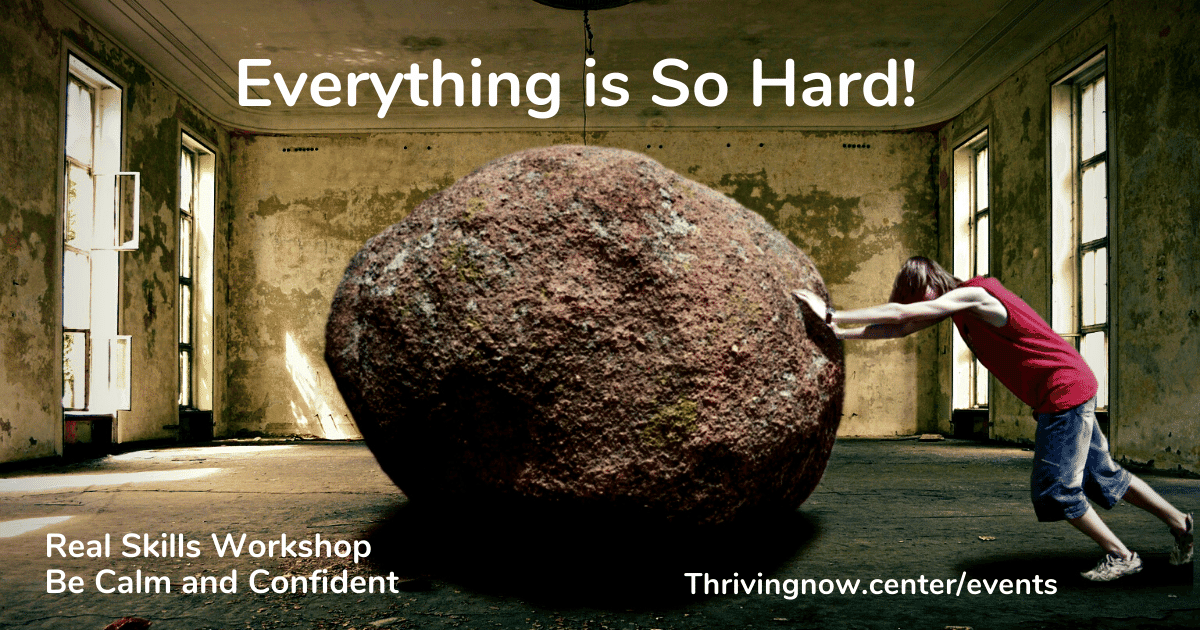
Yet the survival brain often globalizes one hard thing into everything, then adds self-blame, comparison, urgency, and the demand that life should be easy. The original difficulty remains—and now it carries several extra boulders.
The skill is not making every hard thing easy. It is removing avoidable hardness and bringing resource to what remains.
Turn “Everything” Back Into One Thing
When the brain predicts failure, everything can protect us from taking any action at all. Begin by selecting one part:
- What is the specific hard thing right now?
- Where does the hardness live in the body?
- How intense is it from zero to ten?
- What judgments or predictions are stacked on top?
One piece is workable. Focusing on it also teaches the nervous system a process that can transfer to the rest.
Tapping: This Is Hard—and I Am Not Wrong
Side of the Hand: Even though this is truly hard for me, I do not have to pretend otherwise or shame myself for feeling it.
Even though my body has strong opinions about this, those sensations carry information rather than a verdict on my worth.
Even though I wish it were easier, hard does not automatically mean bad, wrong, or impossible.
Top of the Head: This is hard.
Eyebrow: It is hard for me.
Side of the Eye: I may pretend it should not be.
Under the Eye: My body knows how much this asks.
Under the Nose: I acknowledge the weight, tension, or helplessness.
Chin: I do not need to solve everything this minute.
Collarbone: One hard thing is here.
Under the Arm: I can be with this one thing.
Top of the Head: Hard does not make me bad.
Eyebrow: Difficulty is not proof I failed.
Side of the Eye: I can stop fighting the fact that it is hard.
Under the Eye: Acceptance frees some energy for response.
Under the Nose: I can listen for what this needs.
Chin: Support, rest, skill, meaning, or one small movement.
Collarbone: I am letting resource return to my body.
Under the Arm: It is hard enough without attacking myself too.
Notice the Hardness You Add
Common layers include:
- If I were competent, this would be easy.
- I should have known or prevented this.
- Other people handle more than I do.
- Bad things happen because I attracted or deserved them.
- I must finish everything before I can rest.
Self-blame can create an illusion of control: if it was our fault, perhaps perfect behavior can guarantee safety next time. But surprise, loss, illness, layoffs, mistakes, and changing conditions belong to human reality.
If we did make an error, punishment still does not repair it. We can learn without making the already-hard experience harsher.
Tapping: I Should Have Known
Side of the Hand: Even though part of me insists I should have known, prepared, or performed well enough to prevent this, that expectation is impossible.
Even though blaming myself offers a temporary feeling of control, it drains the resource I need now.
Even if I made a mistake, I can learn without sentencing myself to more suffering.
Top of the Head: I should have seen it coming.
Eyebrow: I should have been better prepared.
Side of the Eye: If I were good enough, I would never hurt.
Under the Eye: That is a painfully moving target.
Under the Nose: This is already hard.
Chin: I do not need to make it harder.
Collarbone: Competent people still get surprised.
Under the Arm: Human beings cannot control every outcome.
Top of the Head: What if I did nothing wrong?
Eyebrow: What if I did—and still deserve care?
Side of the Eye: I can separate learning from punishment.
Under the Eye: I can prepare wisely without preparing for every shoe.
Under the Nose: Resilience matters more than impossible certainty.
Chin: I bring compassion to the part that was blindsided.
Collarbone: I am here with what is real now.
Under the Arm: My energy can go toward the next useful response.
Some Hard Things Matter
The primitive brain seeks the least effort because wasted energy once threatened survival. It may treat all difficulty as a reason to stop.
But parenting, grief, intimacy, learning, creative work, rehabilitation, boundaries, and building something meaningful may be hard precisely because they matter. We sometimes choose hard; sometimes hard chooses us.
Hard and miserable are not identical. A meaningful challenge can include nourishment, pride, connection, and aliveness. The question becomes:
Why does this matter to me, and what would help me meet it without abandoning myself?
Resource the Body Before Asking for Strategy
When intensity is at nine or ten, clever plans rarely land. Tap, breathe, move gently, cry, orient, seek co-regulation, or press your feet into the ground. If pain or freeze is present, a micro-movement may remind the system that total immobilization is not required.
As noise decreases, the heart, belly, legs, and muscles can rejoin the conversation. Then ask what might make the task five percent more fun, easy, supported, or meaningful.
Tapping: Allowing Support and Ease
Side of the Hand: Even though hardness has been my companion for a long time, I am open to removing one unnecessary layer.
Even though part of me thinks ease means laziness or danger, support can help me do what matters.
Even though this may remain challenging, perhaps it does not need to be grim, lonely, or all at once.
Top of the Head: Part of me holds onto the hardness.
Eyebrow: It proves I am trying.
Side of the Eye: It keeps me prepared.
Under the Eye: It is also exhausting.
Under the Nose: What could make this five percent easier?
Chin: A friend, music, warmth, a better place, a smaller step.
Collarbone: Meaning can travel with difficulty.
Under the Arm: Play can join without denying the stakes.
Top of the Head: I can break the boulder into small rocks.
Eyebrow: Ten minutes can count.
Side of the Eye: Twenty seconds can count.
Under the Eye: I do not have to muscle through it all.
Under the Nose: I remember why this matters.
Chin: I notice any satisfaction that arrives.
Collarbone: I can do hard without making myself miserable.
Under the Arm: Support belongs in my way of doing hard things.
Make It More Livable
Enhancement is not bribery after suffering. It can be woven into the action: co-work with a friend, walk while talking, choose a nourishing location, play music, use a comfortable pillow, add humor, or work for a bounded interval.
If “do the hard thing, then have fun” guarantees that the fun wins and the hard thing never starts, bring some life into the process itself.
The coffee, companionship, beauty, or rhythm does not make the work unreal. It helps more of us show up.
Practices for Living This Skill
Parse one thing
Replace everything with one specific situation, sensation, or next decision.
Remove the pile-on
Tap on blame, comparison, shoulds, and catastrophic predictions separately from the underlying challenge.
Use micro-movement
When frozen or hurting, try one gentle squeeze, shift, breath, or tiny physical motion within your capacity.
Seek co-regulation
Ask someone to sit with you, listen, work alongside you, or help your system feel safe enough to think.
Remember the why
Name what matters beneath the effort. If nothing matters, reconsider whether the task belongs to you.
Add five percent
Invite ease, play, support, beauty, music, comfort, or meaning without demanding transformation.
Stop at a credible unit
Ten minutes, two applications, one paragraph, or one dish can build capacity better than an impossible demand.
Bringing It Into Your Life
Some seasons contain real cascades. A tiny practice does not erase pain, structural constraint, grief, or exhaustion. It can keep global hardness from swallowing every remaining choice.
We can say, This is hard. It matters. I need help. I can do one part. I refuse to punish myself for being human.
Thriving is not a life without hard things. It is bringing our values, support, and life force into how we meet them.
One thing. Less noise. More resource. The next workable step.
Continue the Conversation
Questions, reflections, and real-life examples are welcome. Continue the conversation about Everything is So Hard! in the Thriving Now Center.