Transcript · Download MP3 · Download MP4
Invitation
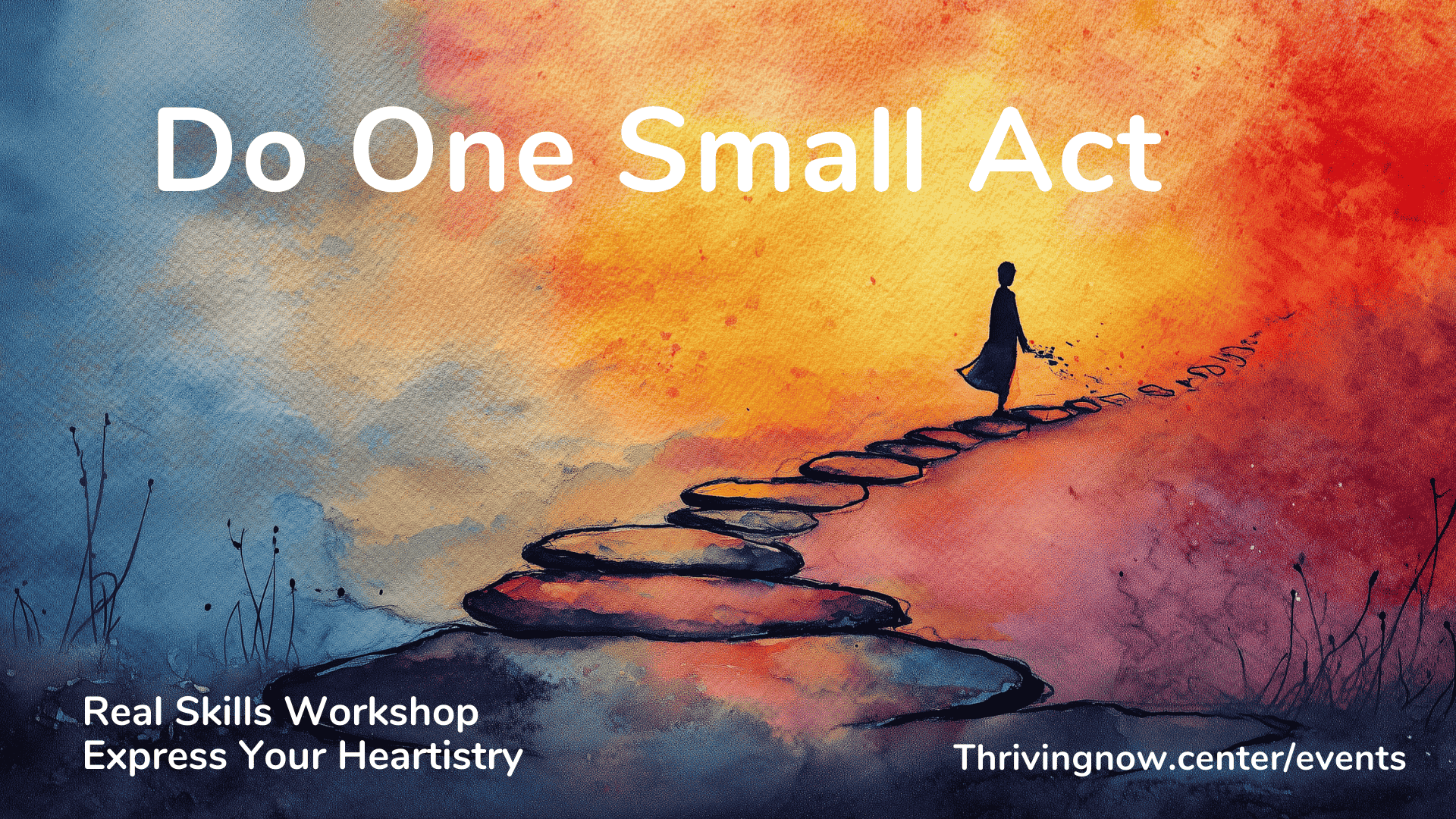
One small act can feel insultingly small. There are thousands of bales of hay, a whole house to tend, a career to rebuild, grief to process, and people whose needs matter. Why bother lifting one?
Many of us were trained to worship the big win. We learned to create adrenaline, threaten ourselves with consequences, and push until the project was finished. That can work in a true survival moment. Used as a way of life, it depletes us and severs intimacy with ourselves.
One small act is not a productivity trick. It is a way to return to relationship with your body, your choice, what matters now, and the self who will live with what you do.
Sometimes the act advances a project. Sometimes it is a blink, a breath, a raspberry at life, an honest I do not want to, or deciding that the commitment belongs back on someone else’s plate.
Small does not mean insignificant. Small means you can be fully here for it.
Be With Here Before Driving Toward There
Most project systems begin with the desired endpoint. Emotional freedom begins with what is.
Before asking what to do, notice:
- What am I feeling about this?
- What happens in my body when I picture starting?
- Is there pressure, rebellion, grief, hopelessness, or fear of failure?
- Do I actually choose this—or only believe I have to?
Being with now is not passivity. It prevents the next action from being built on self-abandonment.
When Frozen, Begin With Voluntary Movement
Freeze makes a task feel physically impossible. Do not demand that your first movement be useful to the project.
Blink intentionally. Wiggle one toe. Stretch your jaw. Put your hands on your hips. Hiss toward the corners. Tap one point.
The body receives new evidence: I am not entirely trapped. I can choose a movement. That may be the only act needed now.
Tapping: You Cannot Make Me
Side of the Hand: Even though I feel frozen and part of me absolutely does not want to move forward—you cannot make me, I cannot make me, and they definitely cannot make me—I choose to be with myself and these feelings now.
Top of the Head: All this rebellion.
Eyebrow: All this resistance.
Side of the Eye: All this procrastination.
Under the Eye: You cannot make me do this.
Under the Nose: I cannot make me do this.
Chin: I have so many feelings bottled up around it.
Collarbone: I should do it.
Under the Arm: I have to do it.
Top of the Head: I said I would.
Eyebrow: They expect me to.
Side of the Eye: I expect me to.
Under the Eye: I had better do it perfectly and quickly.
Under the Nose: Or some part of me believes I am in trouble.
Chin: No wonder I am overwhelmed.
Collarbone: No wonder I do not want to start.
Under the Arm: If I start, does that mean I can never stop?
Top of the Head: This is not kind self-talk.
Eyebrow: I would not speak this way to a trusted friend.
Side of the Eye: What if I choose only one area?
Under the Eye: What if I feel what is true about it?
Under the Nose: I may choose an action, a pause, or a no.
Chin: One voluntary movement is already mine.
Collarbone: I am allowed to stop when the small act is complete.
Under the Arm: For now, this is enough.
Feelings Hide in Crowds
When twenty projects appear at once, the crowd can hide the emotional truth of any one. “Overwhelmed” is real, but it may keep you from meeting the hard candy shell around a specific act:
- If I fail, it proves I am a failure.
- There is no hope, so why bother?
- If I begin, I must finish everything.
- I promised, so my consent no longer matters.
Choose one. Be with the actual act rather than the entire imagined future. Hopelessness may be accurate about one outcome and false about the small change available now. Failure may be an old emotional couch—miserable, but familiar.
Tapping: Pressure Is a Clue
Side of the Hand: Even though I know how to turn up the pressure and invent repercussions, I am willing to notice that pressure is a clue: I may not be in a small act that matters.
Top of the Head: It is okay to feel what I feel.
Eyebrow: If I pressure myself, I feel pressure.
Side of the Eye: A lot of pressure.
Under the Eye: I demand that I do it.
Under the Nose: I threaten myself with consequences.
Chin: Then my wiser system puts on the brakes.
Collarbone: A small act reveals where I actually am.
Under the Arm: It reveals what habitually stops me.
Top of the Head: Is this act truly right for me?
Eyebrow: Is there grief beneath the candy shell?
Side of the Eye: Is there a more creative way?
Under the Eye: Is there a smaller act with more life in it?
Under the Nose: I do not have to solve the entire project.
Chin: I can meet one layer honestly.
Collarbone: Clarity is useful progress.
Under the Arm: I choose the next act without punishing myself into it.
The Small Act May Be Differentiation
Sometimes we are stuck because the project is not entirely ours. We volunteered reflexively, were assigned responsibility, or believe another person’s feelings must be fixed before we can relax.
Differentiation means staying connected while recognizing: You are you. I am me. Your feelings are yours. My feelings are mine.
It does not permit harm or erase care. It lets another adult develop their capacity instead of making rescue the price of connection. You may still offer help—because you choose to, not because their upset becomes your emergency.
The first small act may be noticing: They are disappointed, and I am having my own big feelings about their disappointment. Bringing the attention back inside restores choice.
Tapping: Their Feelings and Mine
Side of the Hand: Even though no one taught me differentiation, and I learned that other people’s feelings were my responsibility, I can begin practicing now.
Top of the Head: Can I feel okay if they are sad?
Eyebrow: That is not what I was taught.
Side of the Eye: I had to make them happy before I could relax.
Under the Eye: We had to agree or something felt terribly wrong.
Under the Nose: What if their feelings are their feelings?
Chin: What if my feelings are my feelings?
Collarbone: We can care and still feel differently.
Under the Arm: Their upset does not automatically mean I failed.
Top of the Head: Adults in my childhood could not handle their feelings.
Eyebrow: They made that my problem.
Side of the Eye: I was little and did not know another way.
Under the Eye: I can keep some of my energy with me now.
Under the Nose: I can offer support without taking ownership.
Chin: I can revise a commitment that was never a real yes.
Collarbone: They can learn to stand without me always lifting them.
Under the Arm: I am practicing being a different person than they were.
Small Acts Can Happen in Energy Space
Not every meaningful act is visible. You may bring someone to mind and feel genuine love, respect, or confidence in their capacity. That shift changes how you enter the next conversation.
You may acknowledge: I wish the dishes were already done. No action yet—just truth. Pressure drops because the unspoken protest has been heard.
You may trust a future version of you: This matters to him. He will tend it when he has the energy. That is not always avoidance. It can be respectful pacing.
Build a Relationship Across Time
A mug carried toward the kitchen, a pitcher filled, an idea recorded, clean clothes put away—each can be a love note to future you.
The loop becomes powerful when future you notices: My past self did this for me. Appreciation deposits energy into the relationship instead of treating care as invisible labor.
Self-love is not only soothing yourself now. It is trusting, gifting, and thanking yourself across time.
Tapping: Let the Small Act Become a Gift
Side of the Hand: Even though part of me says “why bother?” unless the whole thing is done, I am open to one act being complete and valuable on its own.
Top of the Head: Why bother carrying one mug?
Eyebrow: There will still be more to do.
Side of the Eye: My primitive brain wants the giant finish.
Under the Eye: Thriving includes tending without a final victory.
Under the Nose: This act can end when this act ends.
Chin: I do not have to keep going.
Collarbone: I can give this to my future self.
Under the Arm: I can appreciate the past self who cared for me.
Top of the Head: The water is filled because I tended it.
Eyebrow: The idea is here because I wrote one line.
Side of the Eye: The project may become a note—and be complete.
Under the Eye: The unfinished art may be released.
Under the Nose: Creation happens now, not only at publication.
Chin: Small care deserves to be harvested.
Collarbone: Thank you, past me.
Under the Arm: Good morning, future me. This is for you.
Tempering, Not Endless Processing
The more you look, the more feelings may appear. You are not required to process all of them.
Steel is tempered through heat, shaping, and cooling—not by staying in the fire until it melts. Touch one emotional wave, tap, then walk or live your day. A large grief may deserve higher ground, support, and a different time.
Feeling less resilient can sometimes mean a fresh layer is available, not that prior growth vanished. Capacity is specific. You may handle your own disappointment well and still be learning to stay present with a child’s.
One loving thought—I love you; I understand disappointment—can be a resilience-building act even when the other person remains upset.
Find the Act With Life in It
“Update my office skills” may be broad, dull, and organized around guessing what employers want. Ask what work engages you. Talk to three people about what they enjoy. Let a purple dragon help imagine the next job. Ask AI or a trusted friend to propose steps, then take only the first useful one.
The right small act can create a lean forward. If it still feels like a wall, make it smaller or change the context:
- label one drive rather than organize all files;
- start the recorder rather than produce the story;
- say the title aloud rather than build the course;
- declare an unfinished piece complete and recycle it;
- ask one question, without requiring a follow-up.
Practices for Living This Skill
Define the End Before You Begin
Say what makes this act complete. A second action requires a fresh choice.
Start Outside the Project
If frozen, choose a body movement that restores agency before choosing a task.
Choose One From the Crowd
Let the other projects wait. Notice the feelings around this one thing.
Ask Who Owns It
Sort what is yours, theirs, and shared. Return misplaced responsibility kindly.
Close the Appreciation Loop
When you encounter past care, pause long enough to receive it.
Step In and Out
Process one tolerable wave. Cool down. Life itself is part of the tempering.
Bringing It Into Your Life
You do not have to fix it all, feel it all, or know the whole path. You are not required to convert every spark into a finished product.
A small act becomes powerful when it contains consent, presence, a clear ending, and kindness toward the person you are becoming.
Lift one bale. Feel your feet. Tell the truth. Carry the mug. Return the responsibility. Start the recorder. Then let the act be complete.
Be here. Choose one. Complete it. Appreciate.
Continue the Conversation
Questions, reflections, and real-life examples are welcome. Continue the conversation about Do One Small Act in the Thriving Now Center.