
Transcript · Download MP3 · Download MP4
Invitation
Delayed gratification is often presented as a test of character: disciplined people wait, impulsive people grab, and successful people conquer themselves.
That framing leaves out nervous-system reality.
If adults broke promises, resources disappeared, food was scarce, or pleasure was regularly interrupted, taking the marshmallow now may be an intelligent survival response. If you are depleted today, the show, snack, purchase, or scroll may be supplying the only dependable relief your body can imagine.
We do not build a thriving future by shaming the part of us that needs something now.
This skill is about creating a trustworthy relationship across time. Present You matters. Future You matters. Past You has already done countless acts of service that make this moment possible. When these selves become allies, delayed gratification stops meaning deprive myself now and perhaps be rewarded later. It becomes Now FOR Later—a small, chosen act of care moving through time.
The Marshmallow Test May Also Be a Trust Test
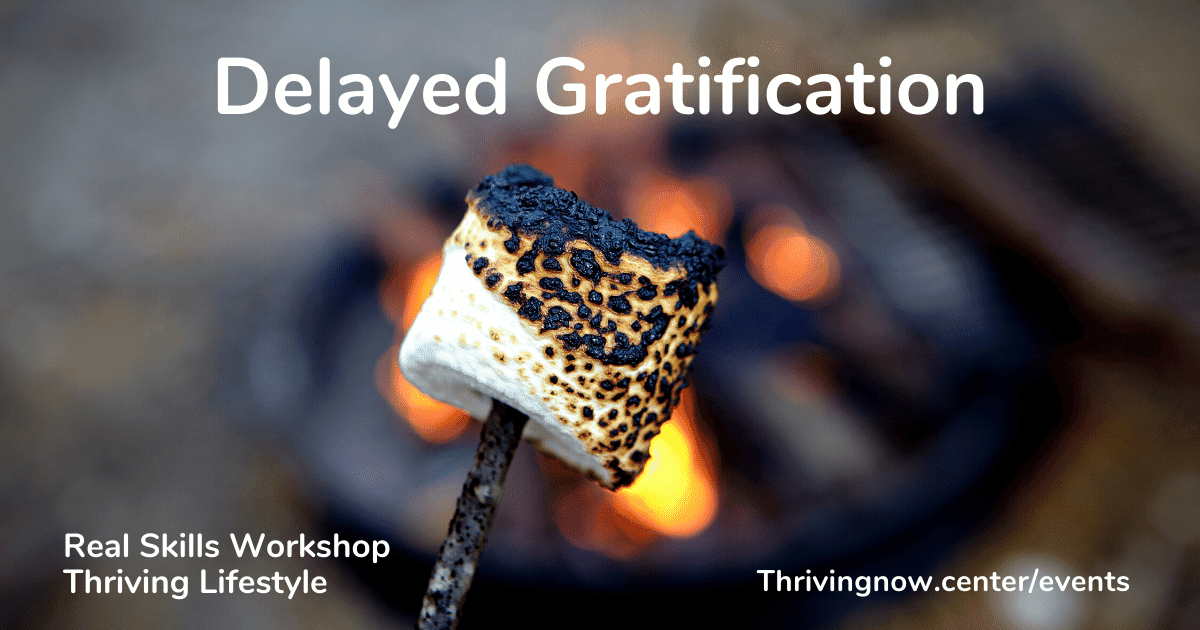
In the famous experiment, children could eat one marshmallow immediately or wait and receive two. Later outcomes were interpreted as evidence that willpower predicts success.
Yet waiting also requires trust. A child must believe the adult will return, the promised second marshmallow will exist, and the first will not be taken away. A child shaped by reliable care and sufficient resources is solving a different problem from a child whose body has learned, Good things vanish. Take what you can now.
This does not make the capacity to wait useless. It makes the path to it more compassionate and accurate.
Before asking, Why do I have no discipline? try asking:
- What does the immediate pleasure provide—relief, comfort, aliveness, escape, control, or nourishment?
- What does my body predict will happen if I pause?
- Have promises of “later” actually been credible in my life?
- Am I asking an exhausted system to delay its only available gratification?
Impulse control changes with safety, energy, attachment, and available nourishment. It is not a fixed measure of worth.
Tapping: What If Later Never Comes?
Side of the Hand: Even though part of me says, “Take it now—later is not trustworthy,” I respect the life experience behind that urgency.
Even though people made promises and did not keep them, my survival brain learned not to leave a marshmallow unguarded.
Even though I judge myself for reaching fast, perhaps this was an attempt to secure comfort when comfort was scarce.
Top of the Head: I want it now.
Eyebrow: Later may never come.
Side of the Eye: Someone could take it away.
Under the Eye: I have waited before and ended up with nothing.
Under the Nose: My body remembers deprivation.
Chin: Immediate relief feels safer.
Collarbone: I am not weak for wanting nourishment.
Under the Arm: I am listening to what this urgency protects.
Top of the Head: Perhaps I can give myself something now and care about later.
Eyebrow: It does not have to be all or nothing.
Side of the Eye: I can make one promise small enough to keep.
Under the Eye: Then I can come back as promised.
Under the Nose: My body can learn from actual evidence.
Chin: Present Me deserves comfort.
Collarbone: Future Me deserves consideration.
Under the Arm: We can begin becoming trustworthy to each other.
Notice whether your system would trust a ten-second delay, a one-minute action, or a promise to return. Start below the threshold of rebellion.
From “Now or Later” to “Now for Later”
Now or later creates opposition. One self gets the pleasure; another gets the burden. One part becomes the harsh authority, while another steals freedom through procrastination or impulsivity.
Now for later creates relationship.
The groceries a past self ordered become breakfast now. Laundry done yesterday becomes clean clothes today. A difficult conversation, a glass of water, money set aside, a skill practiced, or a document labeled clearly can become a gift received hours or years downstream.
The action may still require effort. What changes is its emotional meaning: I am not merely obeying a task. I am making life kinder for someone I care about—and that someone is me.
This also lets gratification arrive more than once. There can be satisfaction while giving the gift and gratitude when receiving it.
Complete the Circuit With Gratitude
Acts of service become depleting when they are continually taken for granted. We can do this to ourselves as readily as others do it to us.
Of course I did the laundry. I had to.*
Why didn’t I do more?
*That hardly counts.
Those responses cut off the energy flow. Instead, when a past action serves you, pause for one breath:
Thank you, Dear Heart. You made this moment easier for me.
The appreciation does not need to be grand. It needs to be real. You know the emotional labor behind the act. You know whether putting away one object, making an appointment, or preparing food required unusual courage or capacity.
Gratitude received later is still gratification.
Delayed Does Not Mean Deprived
Many systems react to delay as punishment: Again? I have to wait again? I never get what I want. This is especially likely when delay was imposed by controlling people or when duties seemed endless.
In that state, “Do the laundry before you watch anything” may feel like banishment from pleasure. The nervous system may reasonably refuse.
A trauma-informed experiment is smaller:
- Enjoy five more minutes of the show deliberately.
- Pause and reassure your system that you intend to return.
- Gather laundry for one minute—or do one tiny step.
- Notice the accomplishment without turning it into an order to clean all day.
- Return to the show as promised.
This is not a productivity trick for squeezing more work from yourself. The return matters. Keeping the promise teaches the body that pausing pleasure does not mean losing it forever.
Tapping: Delay Feels Like Control and Deprivation
Side of the Hand: Even though “wait” lands in my body like control, punishment, and another endless demand, I understand why I resist.
Even though doing one thing used to mean I would be pushed to do everything, no wonder I avoid the first step.
Even though part of me protects freedom by refusing, I want choices that give me freedom now and later.
Top of the Head: I am tired of being told to wait.
Eyebrow: Tired of earning every pleasure.
Side of the Eye: Tired of tasks that never end.
Under the Eye: If I stop the good thing, it may be gone.
Under the Nose: If I do one chore, someone will demand ten.
Chin: Refusing has protected a piece of freedom.
Collarbone: I honor the intelligence in that.
Under the Arm: And I want more than reactive freedom.
Top of the Head: I can choose one tiny interruption.
Eyebrow: One minute does not obligate me to an hour.
Side of the Eye: I can stop when I said I would.
Under the Eye: I can return to what nourishes me.
Under the Nose: No one gets to move the goalposts—not even me.
Chin: This is choice, not willpower warfare.
Collarbone: A little now can serve a little later.
Under the Arm: I am learning that care does not require deprivation.
If your body says the proposed step is still too much, make it smaller. The purpose is credible cooperation, not impressive output.
Build Credibility With Yourself
Trust grows from kept promises, especially small ones.
If you tell yourself you will pause for one minute and then return, return. If you promise only to put away one object, do not convert success into a surprise cleaning marathon. If you plan to handle something tomorrow, leave your future self enough clarity and capacity to do it.
Over time the body learns:
- A pause is not permanent exile from pleasure.
- One task does not automatically become every task.
- Future Me sometimes follows through.
- Present Me will not always be sacrificed.
- We can adjust when circumstances change.
This is secure attachment practiced internally. Not perfect reliability—responsive reliability. When a promise cannot be kept, acknowledge it, explain what changed, and renegotiate rather than disappearing on yourself.
Future You Is Not the Household Servant
Caring for Future You does not mean sending every obligation downstream. It also does not mean Present You must exhaust themselves to make tomorrow pristine.
Sometimes Future You says:
You are too tired tonight. Rest. I can take care of the dishes tomorrow.
That can be loving reciprocity rather than avoidance. The discernment lies in the relationship: Is tomorrow realistically resourced? Does rest genuinely matter now? Is this a conscious handoff or the old reflex of abandoning an unwanted task?
There will be days when serving the future means doing the dishes. Other days it means going to bed.
The skill is mutual care across time, not domination by an imagined more-capable self.
Tapping: I Do Not Trust Myself to Follow Through
Side of the Hand: Even though I have abandoned plans, overpromised, and left burdens for myself before, shame will not make me more trustworthy.
Even though Future Me may feel imaginary and Past Me may seem like a disappointment, we have all been trying to cope with the capacity available.
Even though I want dramatic proof that I have changed, I am willing to build credibility one believable act at a time.
Top of the Head: I have let myself down.
Eyebrow: I make plans and do not follow them.
Side of the Eye: Then I attack myself for it.
Under the Eye: Part of me expects another broken promise.
Under the Nose: No wonder trust is thin.
Chin: Shame is not secure attachment.
Collarbone: Huge promises are not credibility.
Under the Arm: I can begin with what is actually believable.
Top of the Head: One dish, one minute, one clear choice.
Eyebrow: Then I notice that I did it.
Side of the Eye: I let the success remain small.
Under the Eye: I do not weaponize it into more work.
Under the Nose: When the gift arrives, I receive it.
Chin: Thank you, Past Me.
Collarbone: I am here with you, Present Me.
Under the Arm: We are making life kinder for Future Me.
Let one modest act count. Capacity grows more reliably from satisfaction than from self-contempt.
Satisfaction Works Better Than the Reward Treadmill
A reward can carry an implicit message: You endured something awful, so now you have earned relief. That may be useful sometimes, but it can also keep the task and pleasure in opposition.
Satisfaction is available inside the process. Stretching your legs may feel good. A clearer counter may reduce visual stress. Sending the email may release background tension. Acting in alignment with a future need can bring warmth before the future arrives.
Look for five percent more comfort or congruence—not a forced celebration. Immediate feedback helps the primitive brain recognize that this choice has benefits now as well as later.
Practices for Living This Skill
Meet the immediate need honestly
Name what the current gratification provides. If you need rest, comfort, stimulation, or reassurance, include that need in the plan.
Use a tiny interruption
Pause pleasure for ten seconds to five minutes. Do one clearly bounded act, then decide again.
Keep the return promise
If you said you would return to the book, show, bath, game, or rest, do so. This is part of the practice—not a loophole.
Queue gratitude
When you do something for later, imagine the future moment of receiving it. When that moment comes, thank the self who prepared it.
Leave evidence for Future You
Write the next step, set out the needed object, label the file, prepare the food, or reduce tomorrow’s friction.
Let one thing stay one thing
Put away one object without demanding a whole-house cleanup. Preserve credibility by honoring the boundary.
Renegotiate consciously
When capacity changes, speak inwardly as you would in a trustworthy relationship: I know what I promised. Here is what changed. What is the kindest workable revision?
Receive gifts from Past You
Notice clean clothes, available food, a learned skill, a maintained relationship, or any preparation that supports you now. Let it count.
Bringing It Into Your Life
Delayed gratification is not a moral contest between a disciplined adult and an unruly child. It is a relationship among selves who all deserve care.
Sometimes you will choose the marshmallow now. Sometimes you will wait. Sometimes the most thriving choice will be a little comfort now, a little care for later, and gratitude moving in both directions.
We are not trying to become people who can tolerate endless deprivation. We are becoming people whose nervous systems have credible evidence that pleasure can return, small promises can be kept, and the self on the other side of time is worth loving.
Present You matters. Past You matters. Future You matters.
Now for later. Later grateful for now.
Continue the Conversation
Questions, reflections, and real-life examples are welcome. Continue the conversation about Delayed Gratification in the Thriving Now Center.