Transcript · Download MP3 · Download MP4
Invitation
We humans are designed to find comfort. Ease can be delicious. Familiarity lets the nervous system rest.
And then another life impulse rises: I want to explore. I want to make this. I want to speak. I want to feel more alive. I want to find out who I am here.
That impulse often arrives with discomfort. The primitive brain wants answers we do not have yet. The body may tighten. Attraction and repulsion can show up together.
Thriving does not require us to abandon comfort or force ourselves through fear. It asks for a nutritious mix of the safe-and-known and the stretch-and-unknown.
An adventure might be traveling without every hour planned. It might also be posting one piece of art, walking around the block, playing with your child, going to a concert, resting when you habitually work, or turning left because something in you feels curious.
There is no hierarchy of adventures. The real question is whether this experience helps you become more present, choiceful, and alive.
An Adventure Is Not a Forced March
Adventure includes enough uncertainty for discovery. There may be surprise, choice, a block, a change of plan, or an invitation to improvise.
A forced march can look adventurous from outside while feeling coercive within. You go because people will be disappointed, because you should, or because someone says, “Just do it.” Your body is overridden and the destination becomes more important than your relationship with yourself.
Courage is palpably different from willpower. Willpower pushes from behind. Courage is pulled forward by what matters.
That does not mean courage feels calm. It may include fear, conflict, and a very honest I do not know. Courage lets those realities belong without giving any one of them total command.
Hold the Split Screen
Part of you may want the adventure. Another part may fear criticism, pain, getting lost, disappointment, exhaustion, or discovering that you cannot do what you imagined.
Do not rush to settle the argument. Slow down enough to hold both sides:
- I want this.
- Something about it feels unsafe or uncomfortable.
The conflict is not proof that the adventure is wrong. It is information. It may reveal a belief to tend, a resource to add, a risk that deserves respect, or a more personal version of the experience.
Tapping: I Want This—and Part of Me Pulls Away
Side of the Hand: Even though I feel both attraction and repulsion, and this conflict is uncomfortable, I accept that both parts are trying to tell me something. I do not have to shove either one away.
Top of the Head: I have a conflict.
Eyebrow: Part of me wants this.
Side of the Eye: Part of me wants to run, hide, rush through, or forget it.
Under the Eye: Holding both takes skill.
Under the Nose: Holding both takes courage.
Chin: This conflict is not a bad sign.
Collarbone: It is deeply human.
Under the Arm: I want clarity, not coercion.
Top of the Head: What is scary or uncomfortable about this?
Eyebrow: What does that part of me need me to know?
Side of the Eye: Why do I want this?
Under the Eye: What makes it matter to me?
Under the Nose: I can let the answers arrive imperfectly.
Chin: My heart and my protection can be in conversation.
Collarbone: I am allowed to pause here.
Under the Arm: I am listening for the next honest step.
Pause. Write down what came. Do not make the scared part defend itself in court. Its first answer may be blunt, young, or surprisingly practical.
Grow Capacity Without Teaching Yourself That Growth Is Dangerous
If you promise to continue “until it gets too scary,” the survival brain can make it too scary immediately. Then the nervous system learns that approaching the new thing leads to overwhelm.
Instead, microdose the discomfort. Five honest seconds can be enough. Imagine the experience while tapping. Speak one sentence about it. Try a smaller audience. Enter the yellow zone of activation, then return to regulation before orange or red.
This is not endurance for endurance’s sake. We are teaching the system: I can approach this and stay in relationship with myself.
Capacity can expand surprisingly quickly once the body has repeated evidence that you will not drag it past its limits. More is not automatically better. A tiny dose that your system can integrate is real training.
Wise Preparation Is Part of Courage
“Not ready” is not always resistance to eliminate. Sometimes it is accurate.
Preparation can be physical, emotional, financial, relational, or energetic:
- shoes with grip, food, water, medication, or a charged phone;
- your own transportation and a clear exit;
- a pacing buddy or a safer first audience;
- money that helps your system know you can get home;
- rehearsing in imagination while tapping;
- learning the relevant skill before increasing the stakes;
- choosing three minutes of meandering rather than an unstructured day.
Preparation is personal. What settles one body may not register for another. The aim is not to remove every possible risk. It is to become wise-enough prepared for this version of the adventure.
Tapping: Perhaps “Not Yet” Is Helping Me Prepare
Side of the Hand: Even though part of me does not feel ready, what if that is true and useful? I can listen without turning preparation into endless postponement.
Top of the Head: I do not feel ready yet.
Eyebrow: Maybe there is preparation I can do.
Side of the Eye: I can regulate and make a backup plan.
Under the Eye: I can prepare my body, mind, money, or relationships.
Under the Nose: I can microdose the experience.
Chin: There will always be more preparation available.
Collarbone: I do not need perfect preparation.
Under the Arm: I want wise-enough preparation.
Top of the Head: My body’s desire for safety belongs here.
Eyebrow: Adventure is a different state of being.
Side of the Eye: It is a skill I can develop.
Under the Eye: Courage and care can travel together.
Under the Nose: I can identify one resource that would help.
Chin: I can choose the scale that fits me.
Collarbone: I am not proving anything.
Under the Arm: I am preparing to meet life with more of me available.
Find the Experience Beneath the Picture
Sometimes the literal dream is not available. The body cannot do the conventional triathlon. The life season cannot hold a large trip. You are not going to become a prima ballerina at this age.
That does not make the longing foolish. Ask what the picture represents.
Perhaps the triathlon means vitality, pacing, companionship, and moving faster than you do now. Those qualities may be available through swimming, cycling, a wiggly walk, and a trusted pacing partner. Perhaps travel means being immersed somewhere unfamiliar—not doing tourist activities. Perhaps dance means responsive contact and embodied play—not executing prescribed steps.
The form can change while the emotional essence remains alive.
This is not consolation-prize thinking. It is creative fidelity to what matters.
Tapping: The Old Belief Is a Hard Brake
Side of the Hand: Even though the belief says I am too old, too much, not talented, or certain to fail, I am willing to discover whether it is a current fact, an old hurt, or a definition that no longer fits.
Top of the Head: This belief hits like a hard brake.
Eyebrow: It may come from a time when it felt completely true.
Side of the Eye: I do not have to shame myself for carrying it.
Under the Eye: I can separate actual limits from inherited conclusions.
Under the Nose: What experience am I really longing for?
Chin: There may be more than one way to taste it.
Collarbone: I can redefine success so it serves discovery.
Under the Arm: Different is not failure.
Top of the Head: A baby step can still contain the essence.
Eyebrow: I can choose a kinder audience.
Side of the Eye: I can build roots before I share tender growth publicly.
Under the Eye: Criticism does not decide whether this is mine.
Under the Nose: I am allowed to find my own zone.
Chin: I can learn through the experience.
Collarbone: I might discover something wonderful about myself.
Under the Arm: That discovery counts.
High Possibility, Low Expectation
Expectations quietly script the weather, traffic, other people, and our own performance. When reality deviates, the whole adventure can receive an imaginary grade.
Possibility has more space. You can prepare for negative possibilities and remain open to serendipity. You can intend curiosity, pauses, empathy, and self-tending without demanding that you perform them perfectly.
High possibility, low expectation does not mean low hope. It means you stop pressuring reality to prove the adventure worthwhile.
Tapping: Protecting Myself From Disappointment
Side of the Hand: Even though part of me feels hopeful and another part says this will never happen, I recognize a protector trying to spare me disappointment.
Top of the Head: Who am I kidding?
Eyebrow: I have wanted this for so long.
Side of the Eye: Disappointment hurts.
Under the Eye: Sometimes I would rather not try.
Under the Nose: Then I cannot fail or be criticized.
Chin: But not trying has a cost too.
Collarbone: What if I made some real progress this time?
Under the Arm: It may not look the way I pictured.
Top of the Head: I might discover something amazing in the process.
Eyebrow: I can release the fantasy of a perfect day.
Side of the Eye: I can be open to what is actually here.
Under the Eye: I can tend to myself and the group imperfectly.
Under the Nose: Contrast does not ruin the adventure.
Chin: A surprise can become part of the story.
Collarbone: High possibility, low expectation.
Under the Arm: I would really like that kind of freedom.
Let Wanting and Play Come Back Online
Wanting can feel dangerous. Childhood longing may have ended in devastation. Showing desire may have burdened a parent who could not provide. Play may have been interrupted, mocked, or treated as unproductive.
So we mute wanting. We become practical. We keep life goal-oriented and heavy.
But play follows impulses within safe-enough bounds. Without access to what do I want now? it is hard to play, improvise, or direct our life toward what feels ours.
Play is not trivial here. It strengthens present-moment awareness, intuition, flexibility, and the willingness to discover who you are becoming.
Tapping: Letting Myself Want a Little
Side of the Hand: Even though I learned to mute my wanting because empty longing hurt—or because my wanting hurt someone I loved—I am open to wanting and playing in small, safe-enough ways now.
Top of the Head: I learned not to want too much.
Eyebrow: I did not want to feel devastated again.
Side of the Eye: I did not want anyone to feel guilty.
Under the Eye: So I made things less important.
Under the Nose: I made myself less playful.
Chin: That protection made sense.
Collarbone: What if I could want just a little?
Under the Arm: What if I could follow one gentle impulse?
Top of the Head: This is outside my comfort zone.
Eyebrow: Good thing I am practicing.
Side of the Eye: Wanting can give direction to my attention.
Under the Eye: Play can help me discover myself.
Under the Nose: I can have bounds without having a script.
Chin: I can be curious without needing an achievement.
Collarbone: My heart is allowed to spark.
Under the Arm: One small taste is enough for today.
Practices for Living This Skill
Build an Adventure Map
Choose one experience and answer:
- What feels scary, uncomfortable, or repulsive about it?
- What preparation would be wise—physically, emotionally, financially, relationally, and energetically?
- What beliefs act like hard brakes?
- Why does this matter? Keep going until you reach reasons with emotional life in them.
Choose the Smallest Tasty Version
Do not merely shrink the task. Preserve a taste of the quality you want: aliveness, expression, companionship, rest, discovery, or freedom.
Practice Three Minutes of Improv
Walk the familiar path in the other direction. Let your eyes choose where to pause. Take your inner eight-year-old to a safe place and ask what they would enjoy for three minutes.
Make Success Discoverable
Replace “Did it go perfectly?” with questions such as:
- Did I notice something new?
- Was there a moment when I liked being me?
- Did I stay in relationship with my body?
- What became clearer?
- What preparation would help next time?
Cultivate What Goes Flaccid Without Use
Play, eagerness, curiosity, and improvisation are capacities. If one matters to you, give it a light rehabilitation weight rather than demanding two hundred pounds of performance.
Bringing It Into Your Life
The point of adventure is not to become someone who lives outside the comfort zone. Comfort is part of thriving.
The skill is recognizing when habit has become constriction, when a longing carries life force, and when courage can help you cross the edge without abandoning yourself.
Some adventures are dramatic. Others are invisible to everyone but you. Both can change who you know yourself to be.
You do not have to know who you are before you begin. Adventure is one of the ways you meet the self who is becoming.
Wrap what matters in a little uncertainty. Prepare with love. Make the dose small enough to integrate. Let your heart pull rather than your fear or willpower push.
Comfort. Curiosity. Courage. Discovery.
Continue the Conversation
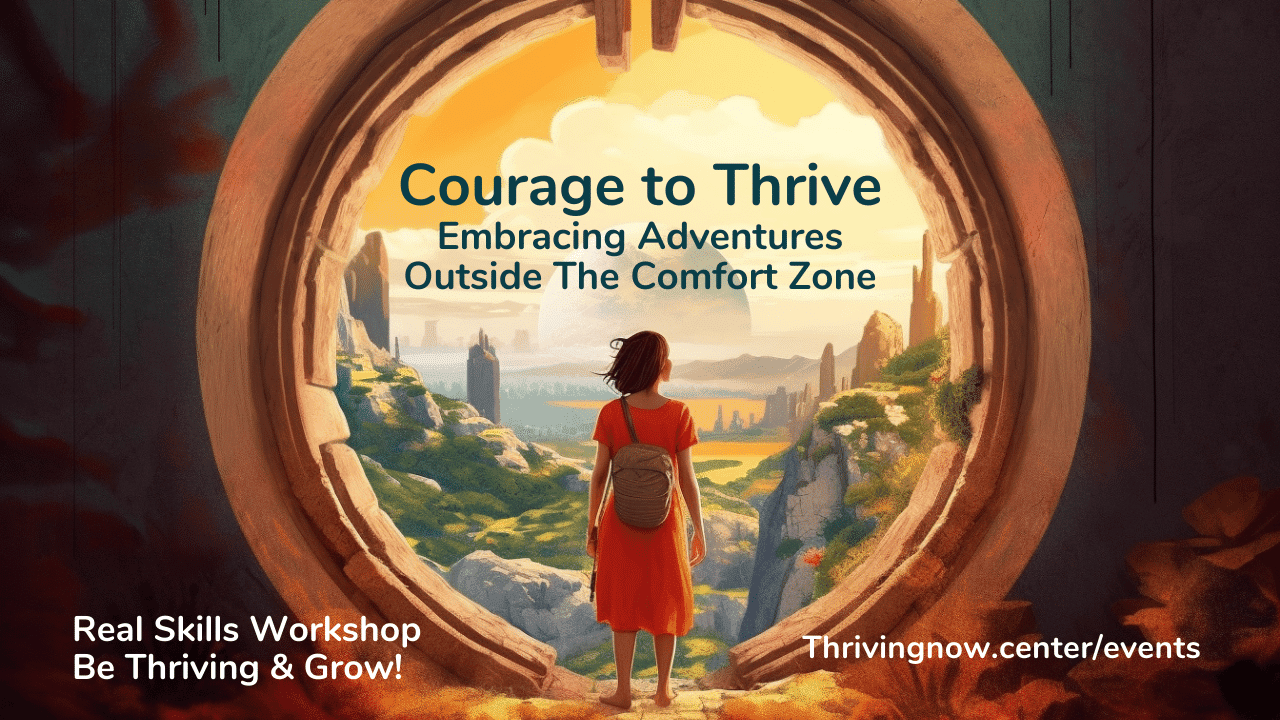
Questions, reflections, and real-life examples are welcome. Continue the conversation about Courage to Thrive – Embracing Adventures Outside The Comfort Zone in the Thriving Now Center.