
Transcript · Download MP3 · Download MP4
Invitation
It can be hard to like a body part that is not working well, has changed in an unwanted way, carries pain or trauma, or is judged by the culture around us. These are not shallow concerns. Our body is how we move, sense, connect, protect, work, rest, and present ourselves in the world.
Body confidence does not require liking every appearance, sensation, or limitation. It begins by reducing hostility enough to create a more workable relationship with the body we have now.
Acceptance is not giving up on change. It is stopping the war long enough to become teammates.
Begin with What You Do Not Actively Hate
When “love your body” feels impossible, find one neutral square inch: the back of a hand, an eye, a fingernail, a patch of skin. Neutrality is a real bridge.
From there, notice function, sensation, endurance, protection, healing, or simple presence. Appreciation does not need to erase pain. It expands the relationship beyond the part currently shouting.
Tapping: My Body Is Wrong and I Have to Carry It
Side of the Hand: Even though I have viewed my body as wrong, burdensome, or a source of pain, it makes sense that liking it has felt difficult.
Even though culture and other people’s judgments activate survival-level status fear, their standards do not define my entire value.
Even though body love is too far away today, perhaps I can find one place that I do not actively hate.
Top of the Head: My body is wrong.
Eyebrow: I have to carry it through the world.
Side of the Eye: People can see what I judge.
Under the Eye: My survival brain hears danger and exclusion.
Under the Nose: I have repeated some of their judgments inside.
Chin: No wonder this relationship feels painful.
Collarbone: I do not have to jump to love.
Under the Arm: One neutral place is enough to begin.
Top of the Head: Is there one part I do not hate?
Eyebrow: One inch that can simply exist?
Side of the Eye: One function I can acknowledge?
Under the Eye: One sensation that is not hostile?
Under the Nose: My body is more than the judged feature.
Chin: My value is more than my body’s status.
Collarbone: A little less war changes how I walk.
Under the Arm: I am building confidence one honest degree at a time.
Every Body Part Is Already in Relationship with Us
We can have an attentive, dismissive, adversarial, terrified, or caring relationship with an ankle, belly, face, scar, nervous system, or painful tissue. Pushing a part away may reduce conscious contact, but it also makes its information harder to hear.
The check-engine light does not disappear because we yell at it. Quiet enough to ask: What do you need? What are you protecting? What can we do together today? Sometimes the answer is treatment, movement, rest, nourishment, accommodation, grief, or professional care.
Tapping: If I Accept This, It Will Never Change
Side of the Hand: Even though I fear acceptance means not caring, not trying, or living with this forever, fighting has not guaranteed the change I want either.
Even though I am angry, hopeless, and tired of this part demanding attention, hatred uses energy we might need for listening and care.
Even though I cannot promise an outcome, I can choose a better relationship with where we are now.
Top of the Head: If I accept this, I am giving up.
Eyebrow: Then it will never improve.
Side of the Eye: I have tried everything I can think of.
Under the Eye: I feel twisted around hopelessness.
Under the Nose: My brain has not solved this.
Chin: Maybe fixing is not the only relationship available.
Collarbone: My body may have information beneath the shouting.
Under the Arm: I can listen without surrendering loving action.
Top of the Head: What do you need from me today, body?
Eyebrow: Five seconds of presence may be enough.
Side of the Eye: A stretch, rest, appointment, boundary, or kindness.
Under the Eye: Body, brain, and universe can be a team.
Under the Nose: We can seek possibilities I have not tried.
Chin: Acceptance and change can coexist.
Collarbone: I am with this body, not standing over it.
Under the Arm: Our relationship can be better tomorrow than today.
Name Shame Without Making It the Body’s Fault
Some shame is imposed by advertising, family, racism, ableism, transphobia, fatphobia, ageism, sexual objectification, and other systems of status and control. Some is connected to what we did, did not do, or believe we should have prevented.
Clearing internal shame does not make external danger imaginary. It gives us more access to values, boundaries, allies, and calm response. We can say, “This body is different from your standard, and I remain a worthy person,” while choosing appropriate safety.
Grieve What Changed or Was Lost
Acceptance may seem to betray the body, ability, appearance, ease, or experiences we once had or hoped for. Grief belongs. So do anger and frustration.
We do not need to insist the change is a gift. We can honor what is gone and still ask what life, pleasure, usefulness, intimacy, and confidence are possible with what remains.
Tapping: I Am Grieving What My Body Used to Be
Side of the Hand: Even though this part of me changed and some of that may be permanent, I am allowed to grieve what I lost.
Even though I blame myself or my body, grief does not require a villain in order to be real.
Even though acceptance feels like betraying my old hopes, I can honor the hopes and meet the body that is here.
Top of the Head: I miss how I used to be.
Eyebrow: I miss what I could do or imagined doing.
Side of the Eye: I am angry this changed.
Under the Eye: I do not know how to fill the gap.
Under the Nose: Some attention and demands were not safe either.
Chin: My feelings can be mixed and true.
Collarbone: Grief is part of this relationship.
Under the Arm: I do not have to exile the changed part.
Top of the Head: We are doing the best we can now.
Eyebrow: I can include this part in loving action.
Side of the Eye: I can respect current energy and function.
Under the Eye: I can seek accommodation without shame.
Under the Nose: I can experience pleasure that is available today.
Chin: I can protect myself from unsafe attention.
Collarbone: Every honest degree changes our trajectory.
Under the Arm: This body and I can keep building trust.
Practices for Living This Skill
Find a neutral starting place
Choose a body area that evokes little hostility and spend a few seconds in nonjudgmental contact.
Ask function and relationship questions
What does this part do, signal, protect, endure, or need? How have you been speaking to it?
Separate acceptance from inaction
List caring actions still available without making self-hatred the price of taking them.
Grieve specifically
Name the ability, appearance, sensation, safety, time, or imagined future that was lost.
Curate the media water
Reduce repeated exposure to bodies presented as the only route to desirability, intelligence, joy, or status.
Build body-respecting community
Spend time where varied bodies, capacities, identities, and aging are treated with dignity and real safety.
Bringing It Into Your Life
We are in relationship with the body until death parts us. The relationship will not be linear. Pain, illness, aging, healing, strength, pleasure, and culture will keep changing the conversation.
Confidence does not wait until the body is perfect. It grows whenever we can be present, listen, act with care, protect our dignity, and let more life move through the body that is here.
**We do not have to adore every part to stop treating any part as an enemy.**
Present. Listening. Grieving. Caring. Teammates in a living body.
Continue the Conversation
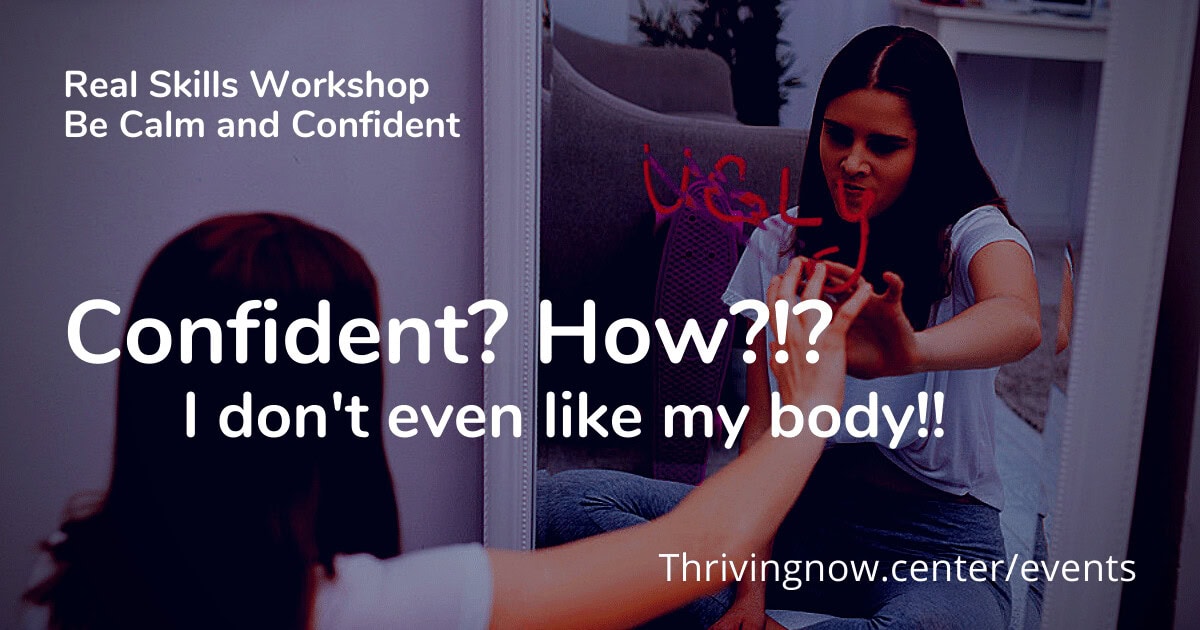
Questions, reflections, and real-life examples are welcome. Continue the conversation about Confident? How?!? I don't even like my body! in the Thriving Now Center.