
Transcript · Download MP3 · Download MP4
Invitation
Calm and confident may not look the way we were taught.
It may not look charismatic, forceful, unflappable, extroverted, or certain. A person can appear quiet while their insides churn. Another can speak with great energy while remaining deeply seated in themselves.
Comparing our insides to someone else’s outsides creates a false target.
Calm confidence is not a personality costume. It is an embodied capacity to quiet what can soften, strengthen what needs tone, and have more of our life force available for what matters.
Calm without confidence can become collapsed, passive, or sleepy. Confidence without calm can become rigid, driven, or flooded. Together they form a living calibration: energy moving down toward support and energy rising toward responsive action.
We will still be startled. Trauma channels will still activate. Other people’s intensity may enter our system. Our chemistry may continue echoing after our mind knows the danger has passed.
The skill is not never reacting. It is learning the feel of our own calm-confidence zone, noticing earlier when we are leaving it, building pathways back, and respecting ourselves when restoration takes time.
Your Calm Confidence Has Its Own Flavor
Calm confidence is not an image we paste over ourselves. It emerges through our physiology, history, temperament, values, and current capacity.
For one person it may feel like quiet steadiness. For another, lively groundedness. For someone who has spent years frozen, confidence may begin as a finger moving, a fuller breath, or the ability to say, “Ouch. I need a moment.”
Ask:
- How do my hands feel when I am calm enough and alive enough?
- What happens in my shoulders, jaw, belly, legs, and voice?
- What level of activation supports the task I am doing?
- What does confidence feel like before it becomes performance?
You do not need calm thoughts in order to calm yourself. You do not need certainty that everything will work out in order to confidence yourself.
The trend matters more than the pose.
Calm Is Not Collapse; Confidence Is Not Tension
Let one wrist go completely limp. That is relaxation, but it is not enough tone to type, hold a cup, or offer steady touch.
Now make a fist. There is plenty of tone, but very little graceful responsiveness.
Between limpness and rigidity is a living range. The wrist can soften while the fingers remain available. The shoulders can release without disappearing. Energy can move down through the body while enough rises to support movement, speech, and choice.
This is why calm and confidence belong together.
- Calming lets excess charge unwind, settle, discharge, or move toward ground.
- Confidencing restores sufficient tone, presence, circulation, and readiness.
We are not trying to drain away our animal energy. We are helping it circulate instead of becoming trapped in buzz, bracing, collapse, or urgency.
Find Your Five
Imagine a 0–10 scale for the nervous-system energy appropriate to this moment. Five is not universally perfect. It is simply a reference point: alert enough to learn, connect, and respond without being driven by alarm.
If you are at six, perhaps a sigh, gravity, tapping, or softer hands moves you toward five. If you drop toward sleepiness, remembering why the moment matters may raise useful tone.
This is lane keeping, not parking. We move a little right, a little left, a little faster, a little slower.
Practice when the stakes are low. The body learns the pathway through repetition:
- Notice your current number without making it a grade.
- Ask whether calming or strengthening is called for.
- Make one small adjustment.
- Recheck the body rather than insisting the technique worked.
The Nervous System and the Soup of You
Electrical regulation can shift faster than biochemistry.
We may calm the immediate jolt and still feel cold fingers, trembling, nausea, agitation, or an internal echo. Adrenaline and other chemistry take time to process. The mind may say, It is over, while the soup of the body continues moving.
That does not mean we failed to regulate.
Support the soup:
- walk or shake gently;
- rub the heart space;
- tap the Collarbone points;
- place a comforting hand near the liver, spleen, belly, or low back if that feels supportive;
- breathe without forcing depth;
- rest before driving or making consequential decisions.
Restoration can be real before it is complete.
Tapping: After a Startle or Sudden Jolt
Side of the Hand: Even though my body reacted before I could choose, that is part of my animal nature. I do not have to pretend I am okay with being startled.
Even though my mind understands what happened and my chemistry is still echoing, I can support restoration without demanding it happen instantly.
Even though part of me wants to be over this already, I am open to returning toward calm confidence surprisingly quickly for this body, this moment, and this jolt.
Top of the Head: My whole system got the alarm.
Eyebrow: That surge happened fast.
Side of the Eye: I do not have to call it funny or harmless.
Under the Eye: My protective nature came online.
Under the Nose: And now I am here, after the jolt.
Chin: I can let the echo move instead of fighting it.
Collarbone: Ouch. I am dropping back into my seat.
Under the Arm: My soup can take the time it takes.
Top of the Head: I am noticing what remains.
Eyebrow: Cold, shaky, buzzy, angry, or alert.
Side of the Eye: I can walk, shake, tap, or pause.
Under the Eye: I can protect myself from another startle.
Under the Nose: A boundary can be part of my calm confidence.
Chin: My reaction is not a character flaw.
Collarbone: I am restoring choice one notch at a time.
Under the Arm: Calm enough to orient; strong enough to care for myself.
Add the Emotional Spice That Matters
The primitive brain understands survival. It does not necessarily understand zest, curiosity, peacefulness, play, or delight.
Once we are calm and confident enough, we can blend in a quality that matters:
- curious calm confidence;
- savvy calm confidence;
- eager calm confidence;
- peacefully alert calm confidence;
- warm, boundaried calm confidence.
Notice how the quality changes posture. Curiosity may lean back and widen the eyes. Zest may bring the torso slightly forward. Peace may deepen the seat.
We are not manufacturing a mood. We are inviting the body to organize around an emotionally meaningful direction.
When You Do Not Understand the Situation
The primitive brain announces itself through urgent language:
I have to. I need to. I can’t. I should. Why? Why? Why? I must figure this out now.
Those phrases are dashboard lights. They suggest that threat physiology may be narrowing perception.
Before trying to understand everything:
- Hold your tongue if speaking would add chaos.
- Feel your seat and feet.
- Put a hand on the heart or belly.
- Let your gaze turn and widen slowly.
- Ask, What matters here? What is actually needed now?
When flooded, we may be like a rider behind eight spooked horses. Screaming at the horses or blaming ourselves will not create a seat. We need enough grip to remain connected and enough settling that the whole system can feel us again.
Calm confidence widens the field before it supplies the answer.
Five Possibilities Before Fixing
Competent people often use problem-solving to escape helplessness. We find one promising idea, become urgent, and push it toward someone who is already hurting.
Before acting in a prolonged difficult situation, see whether you can perceive five possibilities. They do not all need to be good. The exercise reveals whether the primitive brain has reduced reality to I must do this.
Possibilities might include:
- sit nearby without fixing;
- offer water or food;
- acknowledge the pain;
- change state by stepping outside;
- invite contact;
- do nothing yet;
- ask what support is wanted;
- care for your own body while remaining available.
Write your wiser options when you are resourced. A list on the refrigerator or phone can become a gift from your calm self to your future flooded self.
Tapping: Creative Calm Instead of Urgent Fixing
Side of the Hand: Even though urgency wants me to fix this now, I respect how much I care. Scrambling is not my only form of caring.
Even though one idea feels like the answer because I want the pain gone, I am open to sacredly considering several possibilities.
Top of the Head: My fixing energy is racing ahead.
Eyebrow: It thinks urgency proves love.
Side of the Eye: I do not have to become passive.
Under the Eye: I can become more creative.
Under the Nose: What matters here beyond ending my discomfort?
Chin: Presence may be one of the options.
Collarbone: Seat under me, breath in me, choices beside me.
Under the Arm: I can make one humane move without solving the whole reality.
Top of the Head: At least five possibilities.
Eyebrow: Witness, ask, offer, wait, protect, or move.
Side of the Eye: The other person may have their own process.
Under the Eye: I can let their yes guide what happens next.
Under the Nose: I can prepare options without imposing them.
Chin: Calm confidence gives my care more forms.
Collarbone: I trust myself to pause before pushing.
Under the Arm: Creative presence is useful even when nothing is fixed.
Build an Ouch Trail Before You Need It
When words hurt or needs clash, practiced pathways matter.
One simple trail is:
- “Ouch.” Acknowledge internally and, when useful, aloud that something landed painfully.
- “I need a moment.” Claim space before arguing, defending, or complying.
- Re-seat. Ground, tap, move, and let the soup begin to settle.
- Choose the next boundary or request. Return only when enough of you is available.
We blaze a trail by remembering charged situations, tapping with the actual language, and rehearsing the words and posture we want accessible under stress.
Safety trails can be practical. When tailgated, the trail might be: signal clearly, keep movement predictable, find a safe pull-off, allow the other driver to pass, then recover before continuing. As a passenger: Would you be willing to slow down? My nervous system cannot handle this. If not: Please let me out at the next safe place.
Calm confidence does not mean staying in an unsafe situation with a serene face.
Tapping: A Boundary Path Under Pressure
Side of the Hand: Even though this pressure feels threatening and part of me wants to fight, flee, freeze, or submit, I want a pathway that protects safety and keeps choice available.
Even though I hate this energy coming at me, I can acknowledge the hate without letting it steer every movement.
Top of the Head: Ouch. This is affecting me.
Eyebrow: I need a moment.
Side of the Eye: I can feel my seat and my hands.
Under the Eye: I can make my movement clear and predictable.
Under the Nose: I can state what my nervous system needs.
Chin: I do not have to prove they are wrong.
Collarbone: Safety matters more than winning this clash.
Under the Arm: I can leave, pause, signal, or ask directly.
Top of the Head: I am building a trail my body can find.
Eyebrow: Ouch. A moment. Ground. Choose.
Side of the Eye: These words can become available under pressure.
Under the Eye: I respect my sensitivity.
Under the Nose: I respect the safety of everyone involved.
Chin: I can recover after the immediate situation ends.
Collarbone: My chemistry does not have to settle on command.
Under the Arm: Boundaries in motion are part of calm confidence.
Catch Anxiety at Four
If anxiety is already at nine, the exit at four has passed. Restoration may require time, movement, support, sleep, nourishment, and reduced demands.
The skill is not forcing a nine to become a two instantly. It is learning to notice the whisper at two, three, or four.
Tap when you feel the rocket building. Pause when a trigger first enters the body. Over time, early response can reduce how often activation reaches the highest levels.
Preparation also matters. Exhaustion, pain, illness, and prolonged stress reduce capacity. Entering a charged environment after deliberately settling may give us more room to respond.
Freeze Can Become a Powerful Pause
Freeze is often mistaken for calm because the outside becomes still. Inside, breath may stop, awareness narrow, and speech disappear.
When freeze arrives through a trauma channel, do not demand confident performance.
Try:
- press hands gently into the thighs;
- feel the seat and ground;
- move one finger or toe;
- ask, What would make this a real yes for me?
- ask, What does my body need right now?
With sacred attention, freeze can develop branches. It may become a pause from which a boundary, request, delay, or authentic yes emerges.
Micro-strengthening matters. Emotional capacity grows like physical capacity: too much weight too fast can injure and discourage. Choose the one-pound version of the skill.
Economic and Collective Anxiety: Return to Your Field of Influence
Large systems can activate us far beyond what our present action can usefully affect.
Calm confidence does not require ignoring economic instability, political dysfunction, or suffering elsewhere. It asks where our focus becomes service and where it becomes dysregulating immersion.
Return to what matters and what is yours to tend:
- relationships of mutual support;
- adaptable skills;
- practical preparations;
- financial choices that increase appropriate freedom;
- community exchange and generosity;
- five possible adaptations rather than one catastrophic certainty.
We can remain aware without donating every ounce of nervous-system energy to forces outside our current role.
Tapping: Ridiculously Peaceful Anyway—for Right Now
Side of the Hand: Even though this circumstance is not what I wanted, not what I worked toward, and not something I approve of, it is what I am meeting right now.
Even though “acceptance” can sound like surrender, I am not giving up my values. I am reducing the extra cost of fighting the fact that this moment exists.
Top of the Head: I do not have to call this good.
Eyebrow: I do not have to enjoy it.
Side of the Eye: I can be alive inside this unwanted reality.
Under the Eye: I can let gravity hold some of me.
Under the Nose: I can choose the quality I bring next.
Chin: Curiosity, savvy, resourcefulness, or guidance.
Collarbone: Breathing. Here. Alive.
Under the Arm: Ridiculously peaceful anyway—for this moment.
Top of the Head: Peace does not erase action.
Eyebrow: Calm does not erase boundaries.
Side of the Eye: Confidence does not promise the outcome.
Under the Eye: It gives my life force somewhere useful to go.
Under the Nose: I can adapt without rehearsing collapse.
Chin: I can ask what matters in my field of influence.
Collarbone: I choose my next resourceful movement.
Under the Arm: Calm confidence is me having more energy for what I value.
Practices for Living This Skill
Map Your Calm-Confidence Body
Describe hands, jaw, shoulders, belly, legs, breath, gaze, and voice when you are in a workable zone. Use your body, not someone else’s appearance, as the reference.
Practice at Two, Three, and Four
Choose ordinary activation. Notice earlier. Tap, orient, or move before the rocket launches.
Build One Ouch Trail
Select a recurring situation and rehearse the first three milestones your body can follow. Keep the words short enough to survive stress.
Prepare Five Possibilities
For one prolonged difficult situation, write five value-aligned responses while resourced. Include presence and waiting among the options.
Blend One Emotional Spice
After settling, invite curiosity, zest, warmth, play, discernment, or peacefulness. Notice whether posture and energy change.
Respect the Soup
After a jolt, track how long chemistry takes to settle and what assists it. Stop measuring recovery only by whether your thoughts understand.
Use Savvy Questions
Replace What did I do wrong? with:
- What matters here?
- What is my body needing?
- What would make this a genuine yes?
- What is one resourceful next step?
Bringing It Into Your Life
Being calm and confident is not becoming someone else. It is becoming more available as yourself.
You are a human animal. You can be startled, flooded, frozen, manipulated, exhausted, or thrown into old trauma channels. Some days restoration will be fast. Some days the soup will need an hour, a walk, support, or sleep.
The practice is noticing, calming what can soften, strengthening what needs tone, and laying down pathways your body can find when words and choices become harder to access.
Calm confidence does not guarantee comfort or control. It gives you a better seat inside your own life.
Quiet enough to sense. Strong enough to respond. Alive enough to put your energy toward what matters.
Continue the Conversation
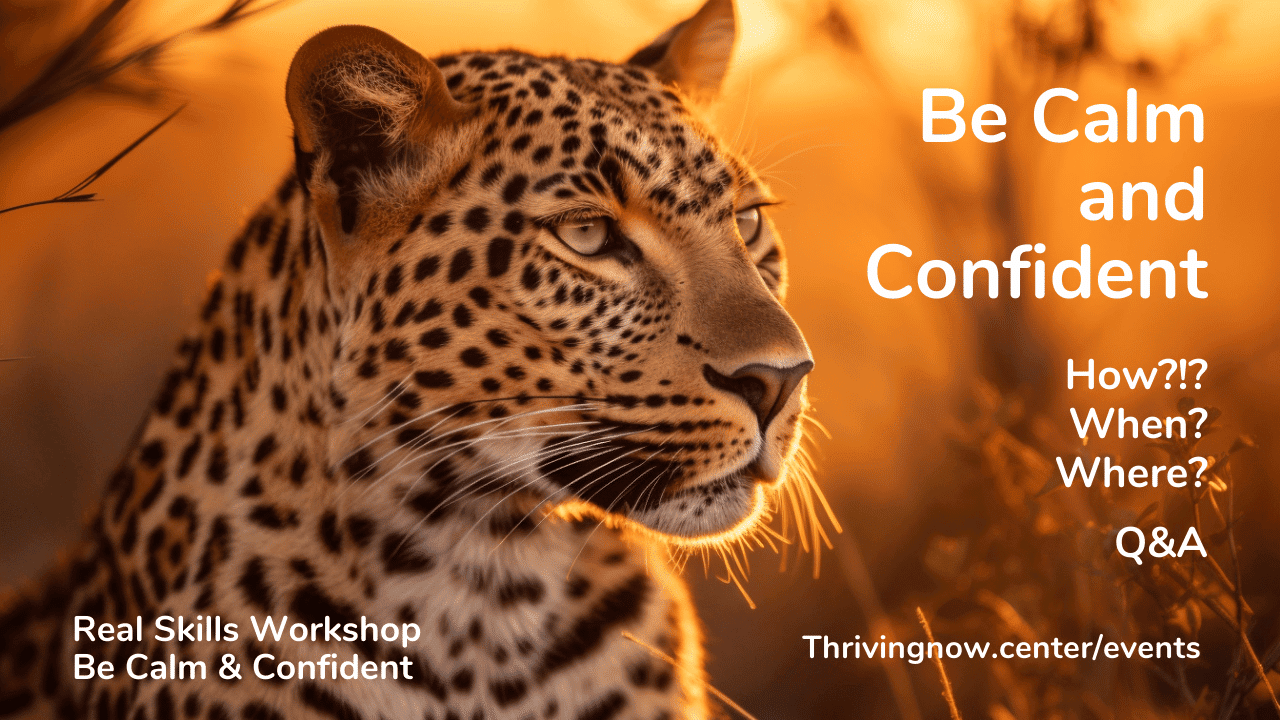
Questions, reflections, and real-life examples are welcome. Continue the conversation about Be Calm and Confident – How When Where Q&A in the Thriving Now Center.