
Transcript · Download MP3 · Download MP4
Invitation
Perfectionism is often praised as high standards. Underneath, it may be an armored identity built around a frightened conclusion: If I do everything right, perhaps I will be safe, valued, loved, and beyond criticism.
The strategy can produce real competence. It also creates vigilance, tunnel vision, self-attack, brittle relationships, and a life where contentment lasts only until the goalpost moves.
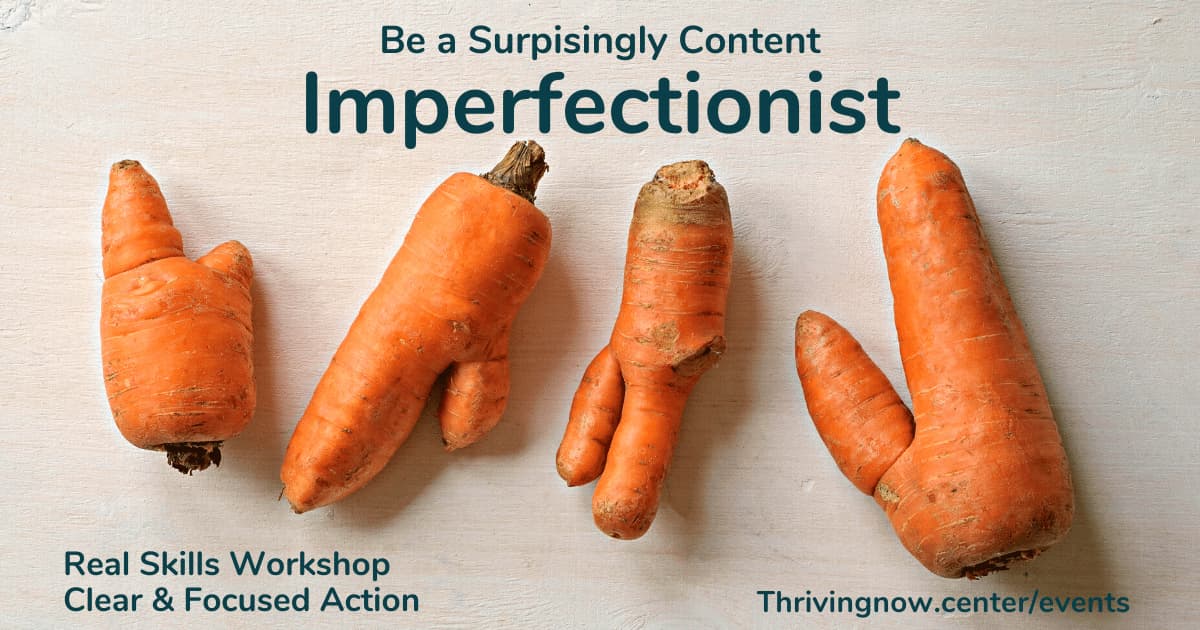
An imperfectionist does not stop caring. We bring appropriate skill, attention, and professional presence—while refusing the fantasy that error-free performance is the price of being okay.
Competence supports our work. Perfectionism conscripts our life force.
Ask What Perfectionism Protects
Imagine being ten percent less perfect in one area. What does your body predict?
- I will be punished, rejected, or exposed.
- People will discover I am inadequate.
- Everything will become chaotic.
- I will lose control, status, or love.
- If I stop pushing, I will become lazy and accomplish nothing.
These fears point toward the protection. A child may amplify a competency to attract advocates or avoid scary adults. A mistake may have threatened belonging. Striving may have been the most available armor.
We do not cuss at that armor until it falls off. We appreciate what it tried to do and build safer ways to belong, learn, and act.
Tapping: I Had to Be Perfect—or Else
Side of the Hand: Even though I was convinced I had to be perfect in order to be okay, I respect how hard I worked to create safety and love.
Even though perfectionism became part of who I thought I was, there may be more of me beneath the armor.
Even though I still want to grow and do good work, fear does not have to be the slave driver.
Top of the Head: I had to be perfect—or else.
Eyebrow: I tried so hard.
Side of the Eye: One mistake felt like proof I was inadequate.
Under the Eye: The goalpost kept moving.
Under the Nose: Contentment never lasted.
Chin: No wonder my body stayed vigilant.
Collarbone: I appreciate the competence I developed.
Under the Arm: I am questioning the terror attached to it.
Top of the Head: I can care without making perfection my identity.
Eyebrow: I can learn without treating every gap as danger.
Side of the Eye: I am already good at some things.
Under the Eye: Not everything—and that is human.
Under the Nose: Curiosity needs room to breathe.
Chin: Growth needs experiments and mistakes.
Collarbone: I wonder what content imperfection feels like.
Under the Arm: More freedom, flexibility, and actual presence.
Retire Should and Have-To From the Diet
Perfectionism feeds on I should be able to do better and I have to get this exactly right. Even success becomes evidence that next time we should achieve twice as much.
Try:
I have done what I have done. It is not perfect. It may still be useful, caring, competent, and enough for this purpose.
Imperfectionism is not pretending we could not improve. Almost anything can be improved. The freedom comes from choosing where improvement matters rather than obeying every imagined critic.
Tapping: If It Is Not Perfect, It Sucks
Side of the Hand: Even though part of me sees only perfect or terrible, I am pretty sure reality contains a spectrum.
Even though I know I could do better, that does not mean this version has no value.
Even though shoulds and have-tos once kept me moving, they now chew up energy without nourishing me.
Top of the Head: Either perfect or it sucks.
Eyebrow: There is no middle.
Side of the Eye: Ninety-eight percent becomes the missing two.
Under the Eye: Finished becomes the next demand.
Under the Nose: My contentment disappears instantly.
Chin: What if there are useful increments?
Collarbone: Good, better, different, enough, alive.
Under the Arm: I can choose the quality this moment needs.
Top of the Head: I release one should from my diet.
Eyebrow: I do not have to chew that rubber band.
Side of the Eye: I can appreciate what works here.
Under the Eye: I can notice the gain, not only the gap.
Under the Nose: Improvement remains available later.
Chin: Completion can be a form of care.
Collarbone: I am allowed to feel content before perfection.
Under the Arm: Surprisingly content—and still capable.
Choose One Quality to Embody
Instead of being perfect at an activity, choose one quality for this pass: graceful, mindful, efficient, playful, kind, present, curious, precise, or nourishing.
Washing a pot mindfully will look different from washing it efficiently. A walk organized around speed differs from one organized around being with the body. Neither quality needs to swallow the whole self. The rest of us remains available to adapt.
This takes pressure off because contentment can come from embodying one chosen quality, not satisfying every possible standard simultaneously.
Match Care to Consequence
Not all tasks deserve the same vigilance. Surgery, safety systems, or handling genuine danger require trained presence and careful standards. Putting away laundry does not deserve bomb-disposal intensity.
Even high-stakes professionals do not control every variable. Their skill includes calm confidence with surprises—not magical perfection.
Ask:
- What is the actual consequence of an error here?
- Who would notice this extra effort?
- What level of care serves the purpose?
- Am I maximizing safety or creating enough safety for freedom?
Tapping: Everything Feels High Stakes
Side of the Hand: Even though my survival brain assigns emergency-level importance to ordinary tasks, I can evaluate what this actually requires.
Even though being careful matters in some contexts, maximum vigilance everywhere harms my capacity where care truly counts.
Even though lowering effort feels risky, I can experiment with one low-consequence task.
Top of the Head: I have to be perfect all the time.
Eyebrow: Every detail feels consequential.
Side of the Eye: Someone might notice and criticize.
Under the Eye: My frightened younger self expects that.
Under the Nose: What is the real risk here?
Chin: Is this surgery—or laundry?
Collarbone: I can bring professional presence where it belongs.
Under the Arm: I can turn down the caring where it does not.
Top of the Head: Appropriate care is not carelessness.
Eyebrow: Enough safety can create room for freedom.
Side of the Eye: I can allocate focus according to what matters.
Under the Eye: My body can guide pace and capacity today.
Under the Nose: I can pause, shift, or leave something unfinished.
Chin: Undone is imperfect—and sometimes right.
Collarbone: My life is larger than this task.
Under the Arm: I choose alive, skillful engagement over rigid perfection.
Let Play and Realness Back In
Perfectionist mode narrows the tunnel: forward, backward, or stop. Biological needs, interruptions, other people, silliness, and spontaneity become annoyances threatening the ideal performance.
Play widens the field. Try an awkward first draft, a deliberately crooked line, a ridiculous voice, or music that changes how you wash dishes. The point is not compulsory fun. It is giving the nervous system evidence that variation and imperfection can coexist with belonging.
Authentic imperfection often creates closeness. A polished wall gives others nothing to hold onto. Sharing a real limitation may let both people relax: Oh, I do not have to be perfect here either.
Choose receptive people. Honesty is not owed to contexts that weaponize it.
Practices for Living This Skill
Try ten percent less perfect
Select a low-risk task and stop before the anxious extra polishing.
Choose one quality
Let this pass be about clarity, kindness, speed, grace, play, or presence—not all of them.
Separate risk from habit
Match attention to actual consequences rather than the volume of fear.
Use an incremental spectrum
Name what improved by one percent or what is already fit for purpose.
Put the reminder where the pattern happens
Use a note such as Be with myself, Gain, not gap, or What matters here?
Practice imperfect visibility
Share something small and real with a person who welcomes humanity.
Let needs interrupt
Drink, rest, use the bathroom, or respond to what genuinely has your name on it.
Bringing It Into Your Life
Perfectionism will reactivate under stress. We may polish a meaningless detail, hold our breath over a minor mistake, or forget the body while trying to be unassailable.
Content imperfectionism is not a permanent achievement. It is a repeated orientation toward proportion, curiosity, presence, and choice.
Our heartistry becomes available when it no longer has to be beyond criticism before it can exist.
Competent. Curious. Human. Surprisingly content.
Continue the Conversation
Questions, reflections, and real-life examples are welcome. Continue the conversation about Be a Surprisingly Content Imperfectionist in the Thriving Now Center.